A gesture made by a Chinese host at the Beijing premiere of Christopher Nolan's latest film The Odyssey has sparked heated online debate over the weekend, after a video showing her crouching while handing a microphone to foreign cast members went viral.
The July 30 premiere Beijing's China Film Museum, attended by Nolan and Hollywood stars including Matt Damon and Charlize Theron, featured an on-site interview session moderated by Chen Xuan, a bilingual host from Shanghai Media Group's International Channel Shanghai (ICS).
During the interview, Chen was seen handing a microphone to foreign cast members who were seated on high stools. She lowered herself into a half-crouching position and leaned forward, appearing almost in a half-squat position, while facing away from the audience and main camera. The posture created a noticeable height difference between the host and the guests.
The short clip, which lasted more than 10 seconds, quickly spread across Chinese social media and triggered widespread discussion.
Some netizens criticized the gesture as "submissive" and "overly flattering," arguing that it reflected a lack of professionalism and that Chen appeared too nervous and showed an inappropriate attitude toward foreign guests.
"There were many ways to avoid blocking the camera, such as standing sideways or asking guests to leave a little space between them," one commenter wrote. "Crouching like this is also not visually elegant."
Others defended Chen, saying the criticism was exaggerated and that the gesture was likely made to avoid obstructing the camera because the guests and host were standing too close together.
"Look at the scene itself. Standing beside the guests for the interview was not practical, so she did it to avoid blocking the camera," another netizen said. "There is no need to overinterpret it. She later stood beside the interviewees without blocking the view."
The incident has reignited online discussions over stage etiquette, media professionalism and how hosts should interact with international guests at public events.
On July 31, Chen posted on Sina Weibo, saying that she was "very happy" to meet director Christopher Nolan again after their previous encounter in 2023 and encouraged audiences to watch the movie in cinemas on August 14.
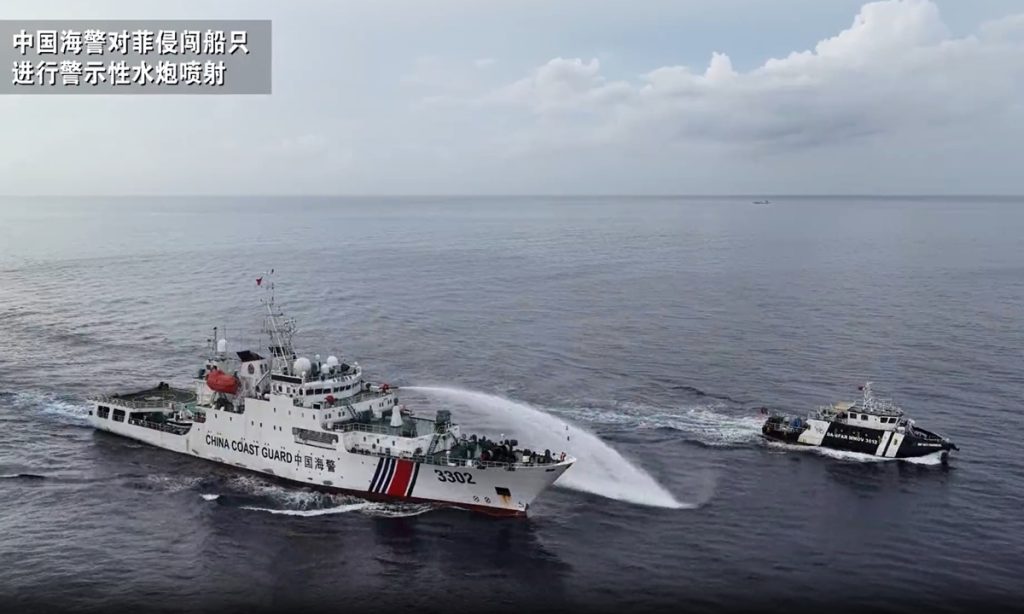
The Philippine government vessels 3012 and 3018, despite repeated dissuasion and warnings from the Chinese side, deliberately intruded into waters under China’s jurisdiction around Huangyan Dao, China Coast Guard spokesperson Jiang Lüe said on Thursday. The China Coast Guard (CCG) took necessary measures in accordance with the law, including tracking and driving away the Philippine vessels, as well as conducting interception and control operations. The on-site operations were professional, standardized, justified and lawful.
Huangyan Dao is China’s inherent territory. We urge the Philippine side to immediately stop its infringement and provocative actions, the spokesperson said.
The CCG will continue to carry out law enforcement and rights protection activities in the waters around Huangyan Dao in accordance with the law, and resolutely safeguard China’s territorial sovereignty and maritime rights and interests, the spokesperson noted.
Two Philippine public vessels (MMOV 3012 and MMOV 3018) ignored repeated dissuasion and warnings from the Chinese side and obstinately intruded into the waters under China's jurisdiction at Huangyan Dao on Thursday. The China Coast Guard (CCG) took necessary countermeasures in accordance with the law to track, monitor and block the Philippine vessels, compelling them to leave the area. The on-site operations by the Chinese side were professional, standardized, legitimate and lawful, the CCG announced in a statement on Thursday.
The incident marked a second provocation by the Philippines in the South China Sea this week and came just one day after Chinese Foreign Minister Wang Yi's meeting with Philippine Foreign Affairs Secretary Ma. Theresa Lazaro on the sidelines of the ASEAN Foreign Ministers' Meeting in Manila, during which Wang noted that it is unfortunate that whenever China and the Philippines prepare to launch dialogue, certain forces within the Philippines, particularly those from the military and law enforcement, deliberately stir up trouble to derail dialogue progress.
These parties harbor malicious intentions: rather than prioritizing the well-being of the Filipino people, they act on the instructions of external forces to advance personal interests, Wang said.
But who is pulling the strings behind the scenes of the repeated attempts to hype maritime disputes and hold the China-Philippines relations hostage? Drawing on public reports, documentary materials and interviews, the Global Times has found that the Philippine military, coast guard, National Security Council and maritime security bodies - long subject to deep US and external influence - have increasingly dominated Manila's South China Sea policy and pushed a confrontational approach toward China.
Some Chinese observers warned that certain actors may be willing to risk escalating tensions, or even triggering a conflict in the South China Sea, in pursuit of their own political and institutional interests.
Chaotic game driven by self interest
Certain forces in the Philippine military manufacture these incidents at sea to hijack the agenda, fuel media hype, and undermine both China-ASEAN and China-Philippines relations. This also reflects divisions within the Philippine government over the country's South China Sea policy, Ding Duo, director of the Research Center for International and Regional Issues at the National Institute for South China Sea Studies, told the Global Times.
Certain figures within the Philippines' National Security Council (NSC), National Task Force for the West Philippine Sea (NTF-WPS), Armed Forces of the Philippines (AFP), and Philippine Coast Guard (PCG) have emerged as influential actors in shaping and implementing Manila's increasingly assertive approach to South China Sea disputes, with some maintaining extensive engagement with external partners.
Yang Xiao, a research professor at the Institute of Peaceful Development under the Chinese Academy of Social Sciences, told the Global Times that the Philippines actions in the South China Sea are a chaotic game driven by internal departmental and personal interests.
By stoking tensions and hyping up issues, factions like the military and coast guard seek to expand their departmental budgets and secure individual gains. Driven by self-interest rather than national strategic rationale, this pattern of behavior renders Philippine actions persistently provocative and inevitably escalates risks in the region, Yang said.
Such "expose-and-benefit" logic can be seen in the so-called "assertive transparency" strategy, which was formally adopted by the Marcos administration in 2023 and centers on proactively publicizing every maritime encounter with China. This reflects the logic of gaining benefits through exposure, according to Yang.
A report from US-based sealight.live in October 2023 noted that the strategy has been accompanied by increased external support, including promises of joint patrols in the South China Sea and assistance in strengthening the Philippines' maritime capabilities. The sealight.live says it uses commercially available technology to shed light on the maritime "gray zone" activities.
Sun Jianxiang, a maritime studies scholar from the China Institutes of Contemporary International Relations, said that parts of the Philippine military and security establishment have an institutional interest in sustaining tensions in the South China Sea. For example, although the army has historically received more funding than the navy, maritime tensions strengthen the navy's case for larger congressional appropriations and increased US military assistance.
Philippine Defense Secretary Gilberto Teodoro Jr called for increasing the country's defense spending to as much as 4 percent of gross domestic product, claiming the Philippines needs to build a stronger military to deter "external threats" as tensions with China persist in the South China Sea, according to a report by Inquirer.net on July 10.
Sun also noted that fishermen, meanwhile, have borne the costs of repeated maritime standoffs since 2012, including restricted access to fishing grounds, falling incomes and mounting debt. The Philippine Coast Guard has been slammed for arming fishermen to engage in provocative offshore activities, using civilians as a front - and at times as human shields - for maritime operations, while diverting attention from fishermen's economic hardships and the government's broader funding priorities, said Sun.
External influence
Whenever China and the Philippines are ready for dialogue, fresh incidents near Ren'ai Jiao often reignite tensions. These confrontations strengthen the case for external involvement and domestic political narratives, while giving outside powers greater strategic leverage and certain Philippine officials more visibility, influence and political capital, said Ding.
One example is Jay Tarriela, the Philippine Coast Guard spokesperson, who is regarded as one of the key figures advancing the so-called "assertive transparency" strategy. According to his biography published by the Manila Dialogue on the South China Sea, Tarriela's academic and professional background includes extensive engagement with Japan and the US.
Tarriela completed his Ph.D. at the National Graduate Institute for Policy Studies (GRIPS) under the GRIPS Global Governance (G-cube) Program in Tokyo as a Japan International Cooperation Agency (JICA) ASEAN Public Policy Leadership scholar. He also holds a Master of Policy Studies from GRIPS and the Japan Coast Guard Academy. He was also selected for the inaugural 2021 Pacific Forum US-Philippines Next Generation Leaders Initiative.
In February, Tarriela was promoted to rear admiral, according to Inquirer.net. However, his high-profile promotion of maritime confrontations has raised questions among some Chinese observers about whether such actions serve the Philippines' long-term interests or those of external players, and whether they provide certain individuals with a platform to maintain public visibility and influence.
According to a report from the philstar.com, Tarriela was accused of being a covert "CIA agent" and supporter of the US government. Inquirer.net also reported that Senator Robin Padilla recently accused Tarriela of escalating "wartime propaganda."
At a higher level, many members of the Philippine political and security establishment have longstanding personal, educational or family ties with the US, which Chinese observers say have shaped their outlook. Defense Secretary Gilberto Teodoro Jr, for example, has been one of the chief architects of Manila's rapidly expanding military ties with the US and Japan. President Ferdinand Marcos Jr is also widely seen as favoring closer alignment with Washington.
"External powers gain access and leverage. Some Philippine officials and politicians gain headlines, promotions and political capital. Ordinary Filipinos, however, pay the price through lost livelihoods, greater security risks and worsening ties with a major economic partner," said Ding.
Without directly naming China, US Secretary of State Marco Rubio issued a pointed critique in an opinion piece published in Philippine newspapers upon his arrival in Manila on Tuesday. He reaffirmed the US commitment to "freedom of navigation" while warning that such freedom "is by no means guaranteed." The remarks have been interpreted by some Chinese observers as the US encouraging the Philippines to confront China in the South China Sea - directively offering Manila a "poisonous drink" that could draw it deeper into regional tensions.
If this cycle of external backing, domestic ambition and maritime friction continues, the Philippines risks becoming a permanent front line in a rivalry it cannot control, Ding said.
The China Coast Guard (CCG) on Friday said it had taken law enforcement measures against multiple Philippine vessels involved in illegal activities in waters off Huangyan Dao, following two consecutive days of provocations by the Philippine side. The CCG urged Manila to stop its actions, warning that the Philippines would bear all consequences.
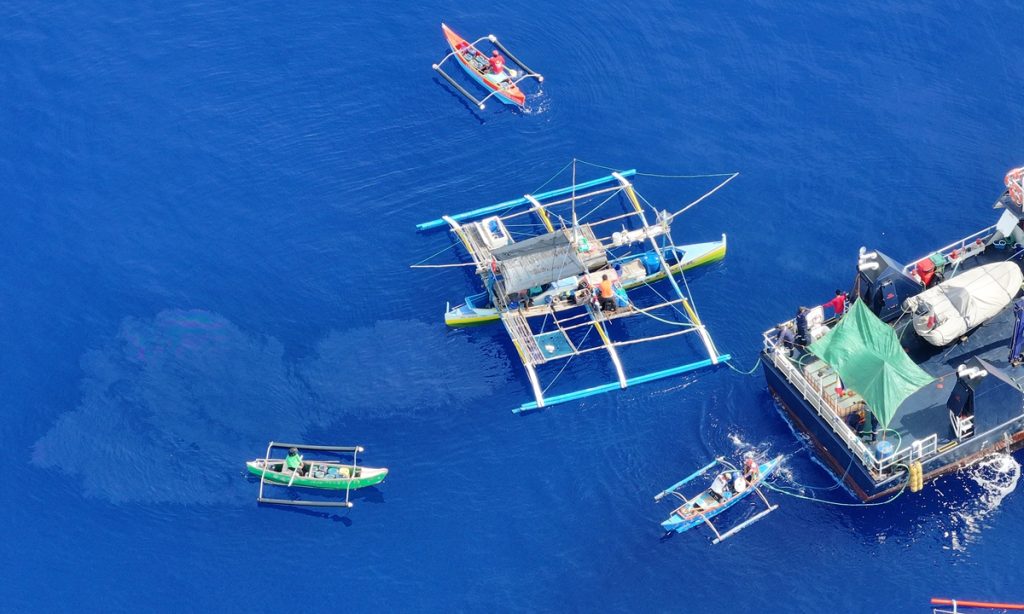
On Friday, the Philippines organized seven government vessels, three coast guard ships, one fish transport vessel, and incited a large number of fishing boats to illegally gather in waters under China's jurisdiction around Huangyan Dao. During the incident, three Philippine government vessels ignored repeated warnings and deterrence from the CCG and deliberately entered China's territorial waters around Huangyan Dao, Jiang Lue, spokesperson for the CCG, said in a statement on Friday.
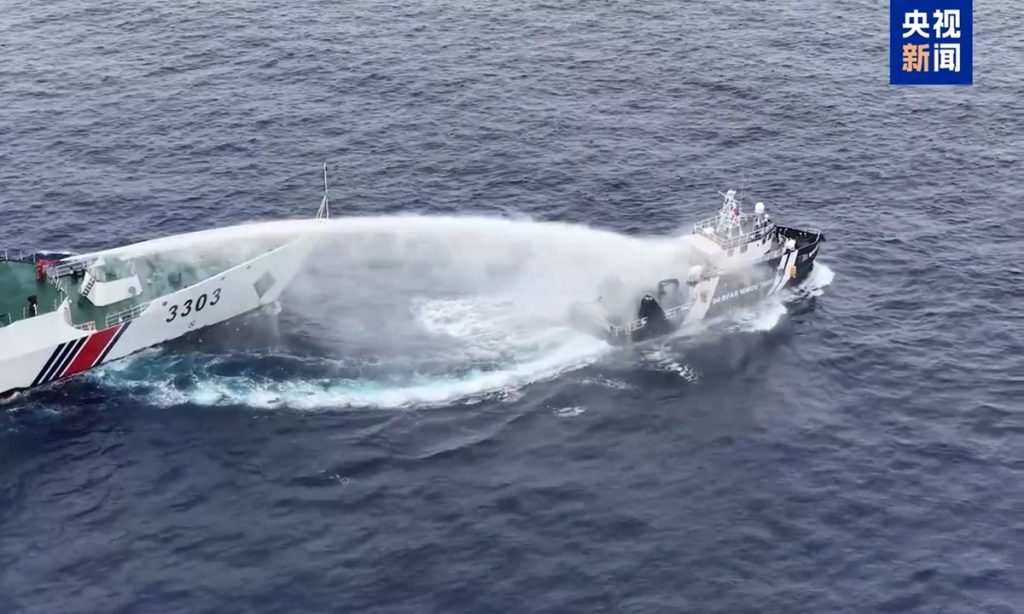
The CCG, in accordance with the law, took necessary measures, including verbal warnings, route control and water cannon deployment, to resolutely drive away the Philippine vessels. The on-site operations were professional, standardized, justified and lawful, said Jiang.
Following the violent assault on CCG personnel by the Philippines at Ren'ai Jiao on July 20, the Philippines has again sent vessels into waters under China's jurisdiction around Huangyan Dao for two consecutive days, deliberately creating provocations at multiple locations in the South China Sea. Such actions have seriously infringed upon China's sovereignty and maritime rights and interests and severely undermined peace and stability in the South China Sea, said the spokesperson.
"We urge the Philippines to immediately stop its acts of infringement and provocation. Otherwise, the Philippines shall bear all consequences arising from its actions," Jiang said.
The CCG will continue to carry out law enforcement and rights protection operations in waters under China's jurisdiction in accordance with the law, and resolutely safeguard China's territorial sovereignty and maritime rights and interests.
On Thursday, two Philippine public vessels (MMOV 3012 and MMOV 3018) ignored repeated dissuasion and warnings from the Chinese side and obstinately intruded into the waters under China's jurisdiction at Huangyan Dao. The CCG took necessary countermeasures in accordance with the law to track, monitor and block the Philippine vessels, compelling them to leave the area, the CCG announced on Thursday.
The Philippines' recent frequent provocations appear designed to amplify publicity surrounding the 10th anniversary of the so-called South China Sea arbitration ruling and to exploit the recently concluded ASEAN meetings to keep the South China Sea issue in the international spotlight. Certain forces in the Philippines have resorted not only to media sensationalism, but also to deliberately engineered confrontations to advance their political agenda, Chen Xiangmiao, director of the World Navy Research Center at the National Institute for South China Sea Studies, told the Global Times on Friday.
Chen also noted that some forces in the Philippines may also be concerned that the South China Sea issue is losing prominence on the agenda of China-US diplomacy, raising fears that Washington's support for Manila could weaken. By initiating fresh provocations, they may be seeking to mislead the international community and secure greater financial, political and security support, particularly from the US.
During the Foreign Ministry's press conference on Friday, a foreign reporter asked about reports that a US journalist team aboard Philippine vessels witnessed a CCG ship moving to within 7 meters of a Philippine vessel and using a high-pressure water cannon, with the Philippine Coast Guard condemning what it called the CCG's "illegal actions."
Spokesperson Lin Jian said that Philippine vessels deliberately intruded into the waters, and it's legitimate and lawful for China to take necessary measures to defend our rights and security. Our actions are professional, standard, and beyond reproach.
"The Philippines must immediately stop infringing upon China's rights, and stop the provocations and publicity stunts. Let me stress that, the Philippines again brought reporters on board in its latest infringement activities and provocations and created tensions at sea by playing up the issue, proving itself to be the saboteur of the peace and stability in the South China Sea and the troublemaker in the region," Lin said.
Chen said that the recent confrontations at Ren'ai Jiao and Huangyan Dao should not be viewed in isolation. Rather, they appear to form part of a coordinated and carefully planned campaign.
Should the Philippines continue down this path, repeatedly escalating tensions without correcting its actions, China reserves the right to take all necessary measures, said Chen, noting that these could include constructing permanent facilities on Huangyan Dao, an exercise of China's sovereign rights under international law, which permits a state to take measures within its own territory and territorial waters.
China could also conduct boarding inspections, detain vessels or take other law-enforcement measures against ships engaged in illegal activities in the relevant waters, said the expert.
China's Ministry of Emergency Management activated a Level-IV national emergency response for geological disasters in northwest China's Gansu Province and dispatched a working team to guide rescue and relief efforts after a landslide struck a village on Tuesday, leaving multiple people buried and dead.
The landslide occurred at around 6:56 a.m. in a village in Nanhe Township, Tanchang County, Longnan City, according to local authorities. A total of 33 people were buried beneath the debris.
As of 2:50 p.m., 21 people had been pulled from the debris, five of whom died despite medical treatment, according to the latest official figures.
The ministry urged local authorities to rapidly mobilize nearby rescue forces, conduct rescue operations in a scientific manner, and guard against secondary disasters.
Local fire and rescue authorities dispatched rescue personnel to the scene, while personnel equipped with a slope monitoring radar were also deployed to assist in the rescue operation.
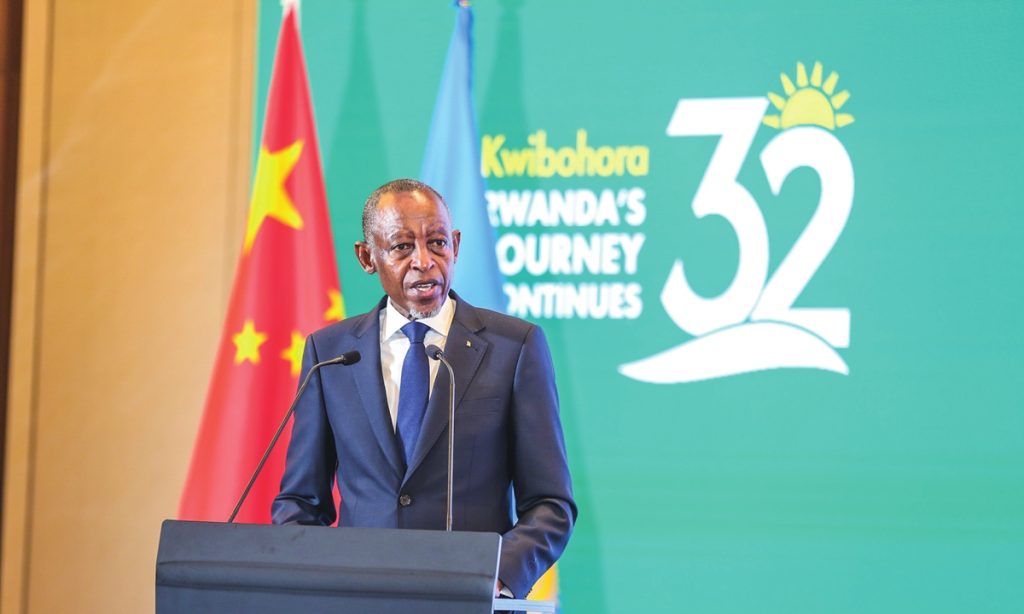
The Embassy of the Republic of Rwanda in China hosted the 32nd Anniversary of Rwanda's Liberation (or Kwibohora32) in Beijing on July 3, where Rwandan Ambassador to China James Kimonyo underlined the role of Chinese investments in Rwanda's development in infrastructure, energy, manufacturing, mining, healthcare, agriculture, education, technology, and many other sectors.
The east-central African country marks Liberation Day every year on July 4, when the Rwandan Patriotic Army ended the 1994 Rwandan genocide against the Tutsi.
Ambassador Kimonyo, in his opening remarks, paid profound tribute to the heroes and heroines who fought courageously and selflessly, some of whom paid the ultimate price to liberate Rwanda. "Kwibohora is not merely a commemoration of victory over evil, but also a celebration of extraordinary resilience of our people and visionary leadership that enabled Rwanda to rise, rebuild and thrive," said Kimonyo.
He said that Rwanda stands as a testament to what can be achieved with a visionary and accountable leadership that puts people at the center of its political agenda, rallying them around a common purpose and a shared vision for the future.
Over the past three decades, Rwanda has maintained strong economic growth, becoming one of Africa's fastest-growing economies.
Kimonyo expressed the mission's appreciation and gratitude for countries and partners who have contributed to the country's growth, and particularly underscored the relations between the Republic of Rwanda and the People's Republic of China that have existed for 55 years.
The ambassador highlighted a few important areas of bilateral cooperation. China stands as top source of Foreign Direct Investment to Rwanda and largest trading partner. Chinese investments have contributed significantly to Rwanda's development in infrastructure, energy, manufacturing, mining, healthcare, agriculture, education, technology, and many other sectors.
As for tourism, Rwanda has increasingly become one of the preferred destinations for Chinese travelers, he added. Liu Xianfa, the Special Representative of the Chinese Government on African Affairs, extended warm congratulations to the government and people of Rwanda over the Liberation Day and expressed sincere gratitude to people from all walks of life who have long worked for China-Rwanda friendship.
Over the past more than 30 years, the Rwanda government and people have achieved national reconstruction in a short period of time, and sustained rapid economic growth, blazing a unique path of governance and development. China sincerely wishes Rwanda ever greater success in realizing its Vision 2050, said Liu.
China-Rwanda friendship surmounts mountains and oceans and enjoys a long history. "Over the past 55 years, despite the changing international landscape, China and Rwanda have always treated each other as equals and helped each other in need, forging a brotherly friendship and yielding fruitful results in cooperation in various fields," he said.
Liu noted that cooperation in agriculture and road infrastructure among other areas keeps making new headways.
Examples include the Giseke Dam and Irrigation Project, a major agricultural and climate-resilience initiative located in the Gisagara District of Rwanda's Southern Province, the China-Africa Cooperation Center on Satellite Remote Sensing Application, a joint initiative that provides African countries with free access to high-resolution Earth observation imagery and spatial software, and the 10-kilometer road upgrading project in Kigali, a key economic artery linking the city center, the Masaka area, and the eastern part of Rwanda.
Most notably, China's full zero-tariff policy for Africa has helped Rwanda increase its exports to China by 42 percent year-on-year in 2025, and its export of coffee, tea and other agricultural products to China shows an upward trend, Liu noted.
China is ready to work with Rwanda to expand cooperation in mining, technology and green development, and set a fine example for the high-quality development and China-Africa cooperation, said Liu.
"We believe that African diplomatic envoys and friends present today will continue to actively promote their countries quality products, fully leverage China's zero-tariff policy, and share the opportunities of China's vast market," he said.
From the first handshake between Chinese and African leaders across mountains and oceans during the Bandung Conference in April 1955 in Indonesia, which opened a new era of South-South economic cooperation, to the strong call on jointly building an all-weather China-Africa community with a shared future for the new era voiced at the FOCAC Beijing Summit, China and Africa have always stood in solidarity through thick and thin for joint development, Liu stressed.
In a world of turbulence and transformation, China and Africa should strengthen solidarity and cooperation, jointly safeguard the common interests of the Global South, and uphold international fairness and justice, Liu pointed out.
China will work with African friends to hold high the banner of peace, development, cooperation and win-win, promote the common value of humanity, build a new type of international relations and advance the four global initiatives, said Liu.
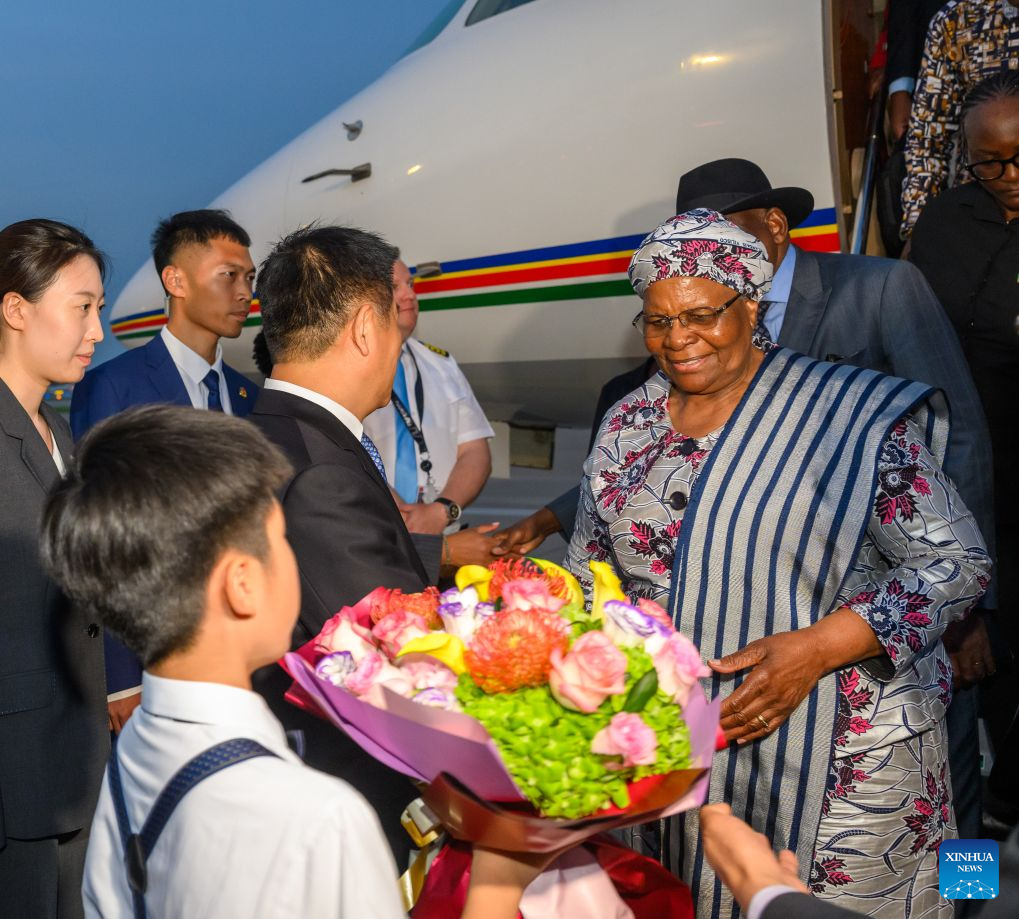
Following a packed schedule of visits in South China's Guangdong Province and Southwest China's Sichuan Province, Namibian President Netumbo Nandi-Ndaitwah arrived in Beijing on Wednesday to continue a state visit to China, the Xinhua News Agency reported.
Some experts on China-Africa relations said on Thursday that the visits demonstrate that China-Namibia cooperation, and even China-Africa cooperation more broadly, has moved beyond the traditional one-way model centered on resources and markets. It is now expanding into a wider range of areas, including industrialization, green development, and the improvement of people's livelihoods, they noted.
Nandi-Ndaitwah visited Chengdu in Sichuan on Wednesday. Impressed by the city's modern agricultural achievements, she said that she would return and that Namibia plans to purchase seeds and equipment, according to a video by Sichuan Daily.
In Sichuan, she also met local officials and representatives from Chinese companies including Sichuan Investment Group, China National Chemical Engineering, and Sichuan Development Holding Co, aiming to deepen cooperation between the two sides, according to Namibian Presidency, the official Facebook account of Presidency of the Republic of Namibia.
This is Nandi-Ndaitwah's first trip to China since assuming office, according to the website of the government of Guangzhou, where she started her week-long state visit in China on Sunday.
Reflecting on the strong comprehensive strategic cooperative partnership between the two nations, the visit highlights a shared commitment to mutual respect, solidarity and sustainable development, which is set to deepen economic cooperation and advance joint initiatives that bring practical advantages to people in both countries, according to Namibian Presidency on Monday.
In Sichuan, the Namibian president also visited the Sichuan Academy of Agricultural Sciences, learning more from agricultural-related technologies, according to the official statement.
Driven by the benefits of the zero-tariff initiative and the complementary market demand on both sides, China-Namibia agricultural cooperation has continued to expand, opening broader access to international markets for Namibian agricultural products. At the same time, China has continued to support Namibia in improving its agricultural productivity, the Xinhua News Agency reported on Saturday.
In Guangdong, the Namibian president visited the China General Nuclear (CGN) Power Cooperation and Chinese tech company Huawei where she also watched a welcome dance performed by robots, according to videos and releases on Namibian Presidency.
From the itinerary, the visit of the Namibian president is a highly pragmatic one with a clearly defined agenda for industrial cooperation, some Chinese experts said.
"From lithium battery manufacturing and skills transfer in Guangdong, to seed and agricultural machinery procurement in Sichuan, each stop featured concrete industrial cooperation objectives. The visit underscored Namibia's development-oriented approach and sent a strong diplomatic signal of solidarity among Global South countries in pursuing shared development and greater self-reliance," Liu Qinghai, research fellow at the Institute of African Studies, Zhejiang Normal University, told the Global Times on Thursday.
According to GDToday, choosing Guangdong as the first stop for Nandi-Ndaitwah's visit in China is no coincidence: the province stands as China's most economically dynamic region and a vital gateway for China-African engagement. Guangdong has forged increasingly close ties with Namibia in recent years through robust trade, high-level policy dialogue, and practical projects that deliver water, jobs, food, and hope.
"Under the framework of the Belt and Road Initiative and the Forum on China-Africa Cooperation (FOCAC), Guangdong will strengthen the alignment of its development strategies with those of Namibia, make full use of policy dividends such as China's zero-tariff treatment for Namibia, and leverage Guangdong's comparative strengths to expand cooperation in mineral resource development, the integrated utilization of new energy, infrastructure construction, and agricultural product processing, Huang Kunming, secretary of the CPC Guangdong Provincial Committee, told the Namibian president on Monday, according to Shenzhen Daily.
Guangdong will also support the entry of high-quality and competitive products from both sides into each other's markets, encourage more Guangdong enterprises to invest and do business in Namibia, promote the upgrading of bilateral economic and trade cooperation, and better support Namibia's poverty reduction efforts as well as its national prosperity and stability, Huang said.
Against the backdrop of the successful 2024 Beijing Summit of the FOCAC, Namibia's visit demonstrated a pathway for deepening bilateral relations under the FOCAC framework: moving from political mutual trust to industrial chain collaboration, and from resource trade to cooperation in value-added processing and manufacturing, Liu said.
Namibia possesses abundant strategic mineral resources, but its exports are still largely dominated by raw minerals or primary products, leaving only limited added value within the country. In the future, China and Namibia could expand cooperation in areas such as mineral processing, smelting, primary material processing, and the testing and certification of critical minerals, thereby enhancing Namibia's mineral processing capacity, Song Wei, a professor at the School of International Relations and Diplomacy at Beijing Foreign Studies University, told the Global Times on Thursday.
"Namibia is endowed with abundant high-quality renewable energy resources, including solar and wind power. Cooperation between China and Namibia in these areas has the potential to become an important driver of Namibia's development," Song said.
Whether in mineral development or green hydrogen projects, success depends on supporting infrastructure such as electricity, water resources, and ports. China-Namibia cooperation in the mining sector will provide important support for enhancing Namibia's industrial resilience, she added.
The Chinese Foreign Ministry on Friday announced that the Minister for Foreign Affairs and External Trade of the Solomon Islands Rick Houenipwela will pay an official visit to China from July 10 to 15, at the invitation of Chinese Foreign Minister Wang Yi.
Against the backdrop of certain external noise aiming to undermine China-Solomon Islands ties, this visit sends a clear signal that the two countries will continue to consolidate their relations and deepen practical cooperation, analysts said.
Elaborating on Houenipwela's visit, Chinese Foreign Ministry spokesperson Mao Ning said at a press briefing on Friday that through this visit, China looks forward to enhancing political mutual trust, deepening mutually beneficial cooperation and promoting the steady development of China-Solomon Islands relations so as to bring more benefits to the two peoples.
Noting that the visit marks Houenipwela's first official visit to China since he took office, Mao said that China and the Solomon Islands are comprehensive strategic partners featuring mutual respect and common development for a new era.
"Since our diplomatic ties were established in 2019, China-Solomon Islands relations have enjoyed all-round and rapid development, standing as a stellar example of equality and mutually beneficial cooperation among developing countries," the spokesperson noted.
In 2019, the Solomon Islands announced in a statement that it recognized the one-China principle and severed the so-called "diplomatic ties" with Taiwan island. In 2024, the two sides agreed to deepen the comprehensive strategic partnership between China and the Solomon Islands in the new era based on mutual respect and common development, and to build a community with a shared future between China and the Solomon Islands in the new era.
Cooperation between China and the Solomon Islands is a two-way partnership based on equality and mutual benefit, free of political strings and solely geared toward win-win development, Chen Hong, director of Asia Pacific Studies Centre at East China Normal University, told the Global Times on Friday.
"Since the establishment of diplomatic ties, the Solomon Islands has seen steady growth in exports of its agricultural, aquatic and mineral products to China," Chen said. "In return, China has delivered tangible benefits to the Solomon Islands' people through practical support in infrastructure, communications, healthcare and education. Bilateral cooperation boasts a solid foundation and broad prospects."
Through mutually beneficial cooperation with China, the socioeconomic shortcomings stemming from prolonged Western colonial exploitation in the Solomon Islands are being steadily remedied, the expert noted.
However, some Western politicians and media outlets have been making unfounded claims against China-Solomon Islands ties.
During a recent visit to the Solomon Islands, Australian Prime Minister Anthony Albanese pledged to deepen bilateral ties with Solomon Islands, while criticizing China's strategic missile launch in the high seas of the Pacific Ocean, according to media reports.
"Australia and its ally the United States have long considered the South Pacific within their sphere of influence," reads a Reuters report, which claimed that though China is Australia's largest trading partner, Canberra remains wary of Beijing's "expanding influence in the Pacific."
Australia's moves bear strong overtones of bloc politics and exclusivity, and it attempts to meddle in the mutually beneficial cooperation between China and the Solomon Islands through coercive pressure and enticement targeting the island nation, said Chen.
By contrast, China maintains an inclusive stance on cooperation between Pacific Island countries and all other nations, as long as such partnerships are not directed against any third party, and stands ready to pursue trilateral and multilateral initiatives with others to advance regional shared development, peace and stability, Chen added.
According to the expert, amid mounting external pressure, pervasive disruptive narratives and widespread uncertainties, the visit delivers an unequivocal message that China and the Solomon Islands will steadfastly consolidate bilateral ties and deepen all-round cooperation.
Direct high-level engagement allows the two sides to exchange in-depth views and align positions on shared priorities, laying a solid foundation for sustained growth of bilateral relations, he noted.
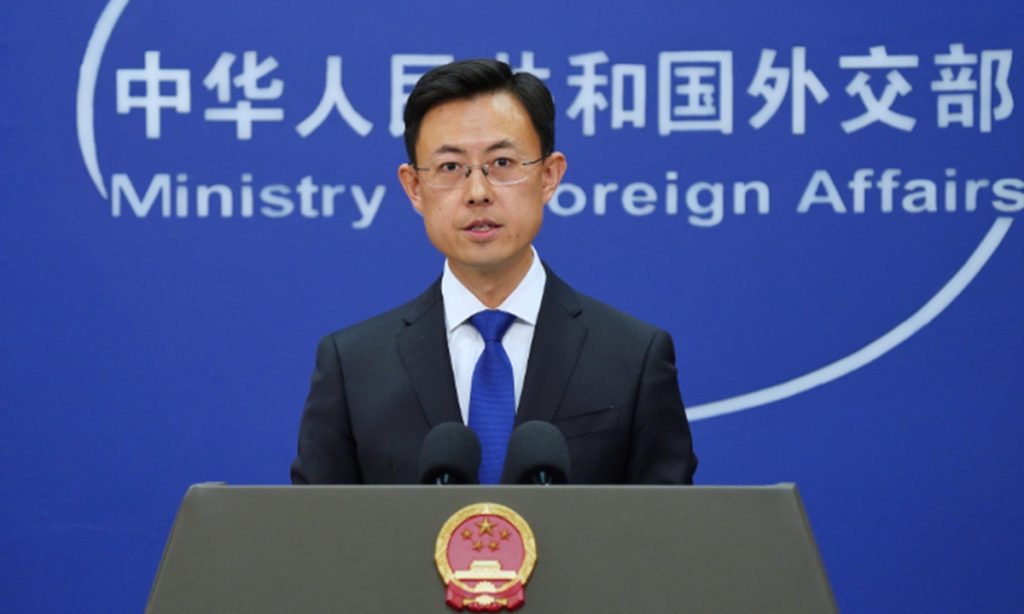
The government and leadership of Paraguay need to ask themselves what the people want, what best serves Paraguay's fundamental and long-term interest and where the arc of history bends, and decide whether they should stop being on the wrong side of history and join the overwhelming majority of countries instead, a spokesperson from China's Ministry of Foreign Affairs said on Wednesday after Paraguay's foreign minister claimed that the country is open to trade with China, as long as it does not have to sever its so-called ties with Taiwan island.
Chinese expert dismissed Paraguay's foreign minister's remarks as an attempt to "have it both ways." Seeking the economic benefits of closer ties with China while harming China's core interests is "wishful thinking," the expert said, adding that such a proposition would never be accepted by Beijing.
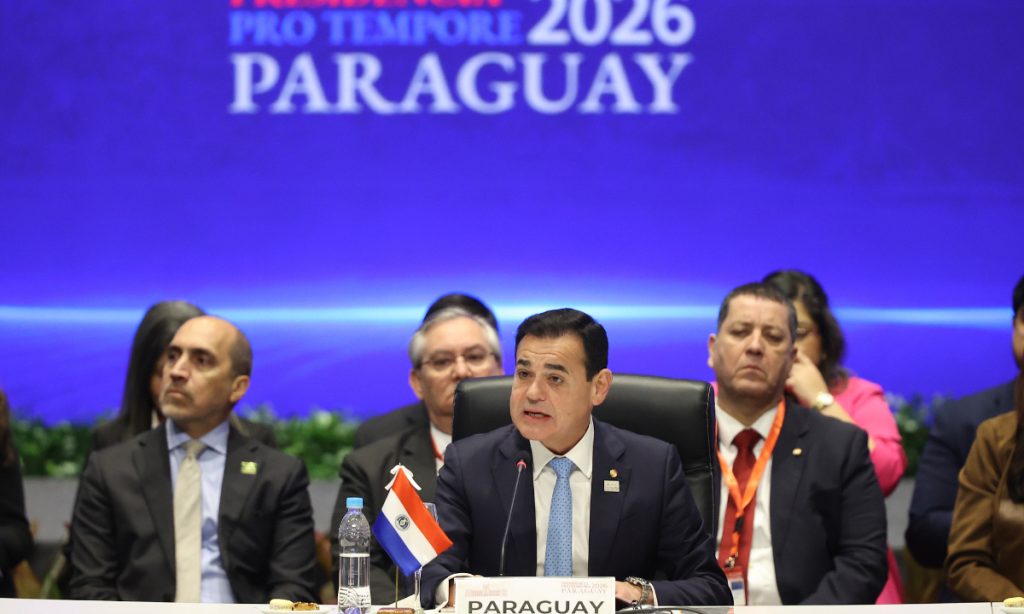
During a summit in Paraguay with leaders of the South American Mercosur bloc on Tuesday, where trade issues were discussed, Paraguay's Foreign Minister Ruben Ramirez said that Paraguay does not refuse to establish trade relations with China, as long as there are no conditions regarding Paraguay's so-called diplomatic ties with Taiwan island, according to the Strait Times.
Paraguay is the only South American country that has so-called diplomatic ties with Taiwan authorities, and is the only Mercosur member that does not maintain diplomatic relations with China.
The claims made by Paraguay's foreign minister are obviously trying to "have it all," Sun Hongbo, a researcher in China-Latin American relations at the Chinese Academy of Social Sciences, told the Global Times, noting that any move that undermines China's core interests will inevitably prompt a policy response. Economic and trade cooperation cannot be separated from political fundamentals, nor can it advance at the expense of China's core interests.
Sun said Paraguay's proposal to deepen trade ties with China while retaining so-called diplomatic relations with island of Taiwan amounted to "wishful thinking." Whether such an arrangement is possible ultimately depends on China's policy, not Paraguay's aspirations.
According to Foreign Trade Report released by the Paraguay's Department of External Sector Statistics, China remained Paraguay's largest supplier of goods as of the end of March 2026, the country's El Nacional reported.
Major imports from China included mobile phones, portable data-processing equipment, and tires.
Ramirez's remarks came after Brazilian President Luiz Inácio Lula da Silva said the South American bloc was advancing talks on an economic partnership with Japan, adding: "Very soon, we want to do the same with China," according to La Tribuna, a Paraguayan newspaper.
As other Latin America countries explore ways to deepen economic ties with China, Paraguay risks confining itself to an increasingly narrow diplomatic position, said Sun, noting that China is one of the world's largest consumer markets and a crucial destination for Latin American agricultural products, energy and minerals, as well as a key partner in infrastructure investment.
Seeking greater access to that market while rejecting the political foundation Beijing regards as non-negotiable ultimately risks hurting Paraguay's own interest. Sun said that the country has reached a point where it needs to reassess the limits of its current policy toward island of Taiwan.
When being asked that Paraguay's president Santiago Peña is visiting Taiwan with a delegation of business leaders in May, Lin Jian, a spokesperson from China's Ministry of Foreign Affairs, said that the one-China principle is a basic norm in international relations and a prevailing international consensus. On the basis of this principle, a total of 183 countries have established diplomatic relations with China.
"We urge the Paraguayan authorities to come to the right side of history as soon as possible, and make the right decision to recognize the one-China principle and sever so-called diplomatic ties with the Taiwan authorities," said Lin.
At the invitation of Denmark's Minister for Foreign Affairs Lars Lokke Rasmussen, Sweden's Minister for Foreign Affairs Maria Malmer Stenergard, Finland's Minister for Foreign Affairs Elina Valtonen, and Norway's Minister of Foreign Affairs Espen Barth Eide, Member of the Political Bureau of the CPC Central Committee and Minister of Foreign Affairs Wang Yi will visit the four countries from July 2 to 8, a Chinese Foreign Ministry spokesperson announced on Tuesday.
Asked about China's views on relations with Denmark, Sweden, Finland and Norway and expectations for Wang's upcoming visits, Chinese Foreign Ministry spokesperson Guo Jiakun said on Tuesday at a regular press conference that the four countries are among the first European countries to recognize and establish diplomatic relations
Guo said recent years have seen steady and robust development of relations between China and the four countries, with fruitful cooperation in green transition, trade and investment, and sci-tech innovation, and broad-based consensus on upholding multilateralism and free trade and joint response to global challenges, including climate change.
During the visit, Wang will hold talks with his counterparts in the four countries respectively to have in-depth exchanges of views on bilateral relations and international and regional issues of mutual interest, the spokesperson said.
Feng Zhongping, director of the Institute of European Studies at the Chinese Academy of Social Sciences, told the Global Times on Tuesday that the visit is expected to not only focus on international issues, but also on deepening cooperation in areas such as green transition, innovation and trade, while reaffirming shared support for multilateralism and free trade at a time of global uncertainty.
Although bilateral relations between China and the four countries may have encountered some challenges, policies among the Nordic countries on China are now showing a trend toward returning to pragmatism. This is a reflection of their recognition of China's important role in advancing multilateral cooperation, Feng said.
At the press conference, spokesperson Guo outlined the strategic positioning of China's bilateral relations with the four countries respectively. He said that Denmark is China's comprehensive strategic partner in Northern Europe, adding that this will be the first visit by a Chinese foreign minister to Denmark in 15 years, and the first high-level face-to-face meeting after the new Danish government took office. China hopes to consolidate mutual trust, expand cooperation and deepen friendship with Denmark through the visit to open up new prospects for the China-Denmark comprehensive strategic partnership, Guo said.
Sweden is China's largest trading partner in Northern Europe. The upcoming visit will be the first by a Chinese foreign minister to Sweden in 22 years. Through the visit, China looks forward to enhancing communication, deepening mutual trust and expanding cooperation with Sweden to consolidate the sound momentum of growth in bilateral relations, the spokesperson said.
China and Finland are future-oriented new-type cooperative partners. Recent years have seen successive visits to China by Finnish President Alexander Stubb, Speaker of Finnish Parliament Jussi Halla-aho, and Prime Minister Petteri Orpo. The two sides have had close high-level exchanges and fruitful practical cooperation in various fields. China hopes that the visit will enable the two sides to better deliver on the important common understandings between the leaders and provide fresh impetus for the development of the China-Finland partnership, Guo said.
Norway is one of the first countries to recognize China's market economy status. Prime Minister Jonas Gahr Store visited China in 2024 as the two countries marked the 70th anniversary of diplomatic relations, which gave a strong boost to the development of bilateral ties. Through the visit, China will work with Norway to deliver on the important common understandings between the leaders, have in-depth exchanges of views on green transition, global governance, and other bilateral and multilateral issues, and promote the continued steady and sound development of China-Norway relations, said Guo.
Feng said that the invitation from the four Nordic countries, together with Wang's multiple visits to Europe since the beginning of the year, symbolizes a shift in which many European countries are increasingly recognizing China's importance as a partner.
At the Munich Security Conference in February, Wang said that China and Europe are "partners, not opponents, and certainly not "systemic rivals,'" adding that "Europe's challenges do not come from China" and urging joint efforts with the EU to address global challenges.