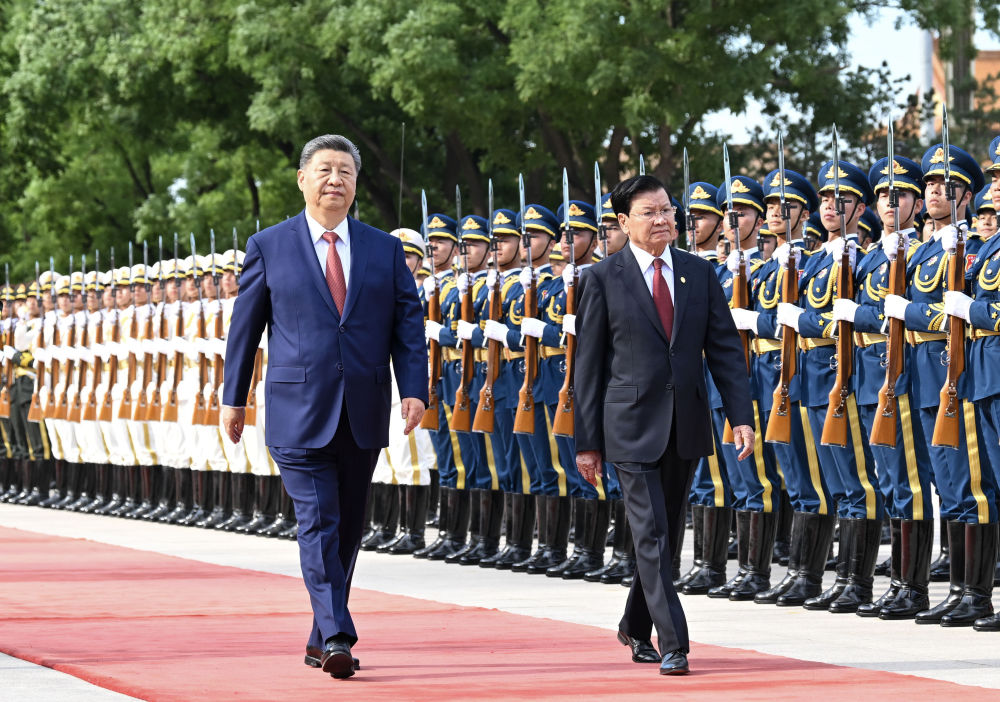
General Secretary of the Communist Party of China Central Committee and Chinese President Xi Jinping held talks with General Secretary of the Lao People's Revolutionary Party Central Committee and Lao President Thongloun Sisoulith in Beijing on Friday.
Chinese Vice President Han Zheng met with Belarusian First Deputy Prime Minister Nikolai Snopkov in Minsk on Saturday.
Han said China and Belarus are good friends and good partners. China is ready to work with Belarus to implement the important consensus reached by the two heads of state, enhance strategic mutual trust and deepen mutually beneficial cooperation to bring more benefits to the two peoples.
Noting China and Belarus enjoy strong economic complementarity and broad prospects for cooperation, Han said China is willing to strengthen the alignment of development strategies with Belarus and continue to open up new space for win-win cooperation.
He called for joint efforts to build the China-Belarus Industrial Park into an international industrial hub, welcomed more high-quality Belarusian products to the Chinese market, and urged both sides to step up youth exchanges to foster closer ties between the two peoples.
Snopkov said Belarus admires China's remarkable development achievements, and firmly believes the Chinese modernization will greatly contribute to world peace, development and common prosperity.
Belarus will always be a trustworthy and reliable strategic partner of China, he said, adding that his country is willing to work with China to implement the important consensus reached by the two heads of state and fully leverage existing bilateral cooperation mechanisms to enhance people-to-people exchanges and expand industrial cooperation.
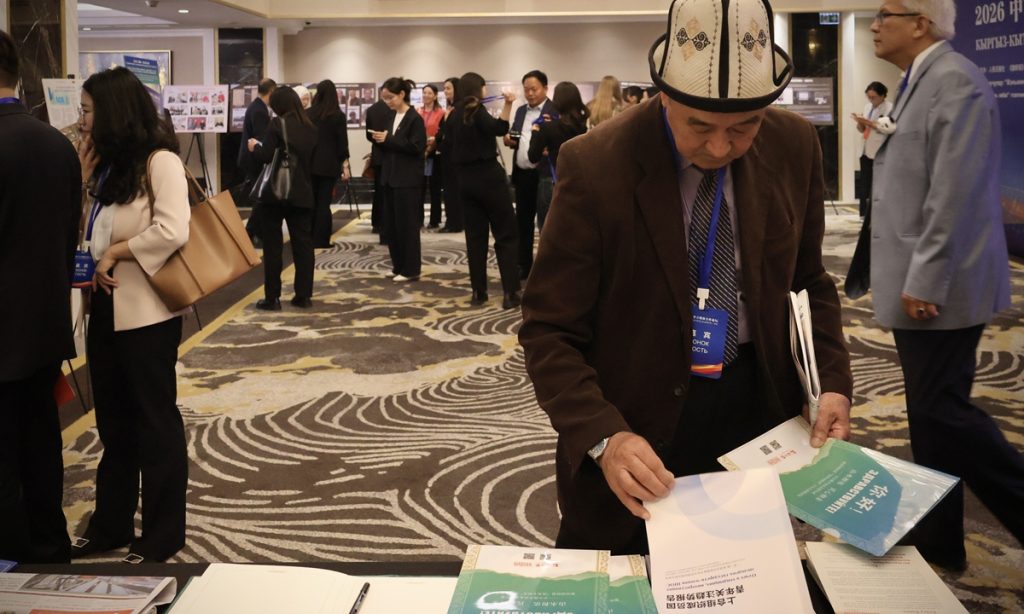
Young people across the Shanghai Cooperation Organisation (SCO) widely endorse the concepts and actions of the SCO, highly appreciate its positive role in global governance and hold high expectations for deepening cooperation across various fields among member states, according to a report released in Bishkek, Kyrgyzstan, on May 27.
The report on interest trends among youth in SCO member states was jointly released by the Secretariat of the Belt and Road News Network (BRNN) and the Global Times at the 2026 China-Kyrgyzstan Media Cooperation Forum held in Bishkek. It is based on a 2025 survey of 10 official SCO member states, as well as data from Global Public Opinion. Focusing on youth perceptions and emerging trends, the report finds that young people are highly invested in employment, entrepreneurship, education, cultural ties, and global partnerships.
The findings show that young respondents strongly identify with the principles of the Shanghai Spirit, featuring mutual trust, mutual benefit, equality, consultation, respect for diverse civilizations and the pursuit of common development. More than 80 percent of respondents believe that development cooperation within the SCO framework has brought tangible benefits to their own countries. Among them, 72 percent cited "promoting high-quality development in home countries," and 62 percent pointed to "bringing more international cooperation and development opportunities." Over 80 percent also affirmed the SCO's positive role in global governance.
China, as a founding member of the SCO, has consistently upheld and acted on the Shanghai Spirit by deepening practical cooperation in various fields with other member states and promoting shared development. The survey shows that among young respondents in SCO countries other than China, more than 90 percent of respondents believe that cooperation with China can positively impact their own country's development and modernization.
More than 90 percent of respodents said that China's development experience in multiple areas is worth learning from. These figures reflect a strong desire among young people across the SCO to deepen cooperation with China and benefit from shared development opportunities.
People-to-people exchanges are one of the most-watched areas of cooperation for young people in SCO member states. More than 90 percent of respondents said they look forward to future SCO cultural and exchange programs and activities. Among the most popular were "youth exchanges," "university/student exchanges," "foreign language learning," and "vocational training." The report concludes that young people are not only interested in macro-level cooperation between countries, but also place great importance on the real-world opportunities brought by education, skills and cross-cultural communication.
Moreover, the concerns of young people in SCO member states show clear contemporary characteristics. Hot topics such as AI, skills development and cultural consumption have become key indicators of trends in employment, education and cultural life. According to the survey, in 2025, media coverage of topics related to "youth," "employment" and "entrepreneurship" in SCO member states saw a 141 percent year-on-year increase in mentions of AI. AI is emerging as an important driver for young people to explore innovation and expand their career opportunities. In education, young people place a high priority on digital skills, practical skills and innovation capabilities, with a clear trend toward digital, remote and cross-cultural learning. At the same time, young respondents maintain a strong sense of their own cultural identity and are developing a cultural awareness that is both locally rooted and globally minded.
Youth represent the future of the SCO and are an important force driving regional cooperation and shared development. The report provides a concentrated picture of the common understandings, real concerns and development expectations of young people in SCO member states, offering a valuable public opinion reference for deepening youth cooperation. Despite a complex and changing international environment, young people in the SCO remain positive about multilateral cooperation and shared development - a sign of the deep youth base and broad prospects for SCO cooperation.
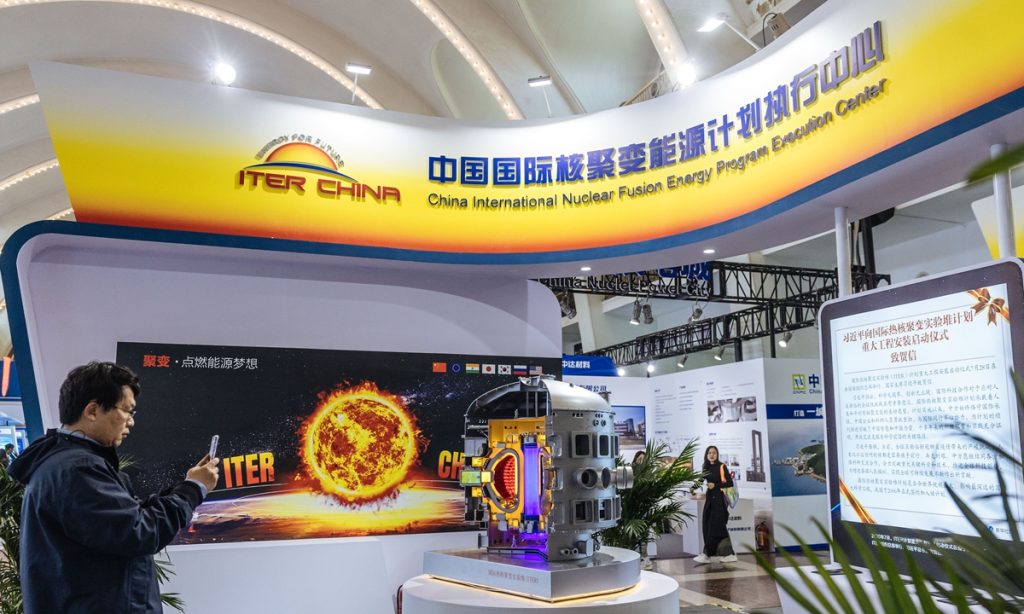
China National Nuclear Corporation (CNNC) has opened ten of its nuclear technology research facilities and testing platforms, including China's new-generation "artificial sun" Huanliu-3 (HL-3) tokamak, to the world for the first time. The move will further enhance China's influence in nuclear science and technology globally, injecting strong "nuclear power" into promoting win-win cooperation worldwide, the Global Times learned from CNNC at a press conference on March 19 in Beijing during the 17th China International Nuclear Industry Exhibition.
This batch of facilities also include the world's highest-energy compact proton cyclotron accelerator the Beijing Radioactive Ion-beam Facility (BRIF), one of the "world's six major neutron sources" China Advanced Research Reactor, the Beishan Underground Research Laboratory (Beishan URL) located 560 meters underground, and the Minjiang Test Reactor for medical isotope research, among others. Many of these facilities have reached world-class level and even lead the industry globally, showcasing the hard work of Chinese researchers and demonstrating the "hardcore strength" of China's nuclear industry innovation.
The HL-3 tokamak, China's largest and most advanced tokamak, is designed to support the operation of the International Thermonuclear Experimental Reactor (ITER) and the development of future fusion reactors.
The Beishan URL in Northwest China's Gansu Province, China, is the country's first large underground research facility used for the safe disposal of high-level radioactive waste. It is an important research facility for the International Atomic Energy Agency and the China Atomic Energy Authority, playing a crucial role in China's nuclear fuel closed-loop technology innovation system.
The BRIF, the only operational online isotope separation radioactive ion beam facility in Asia, can produce over 60 stable nuclear beams and 55 radioactive nuclear beams. It fills the technological gap in China's medium-energy high-current proton cyclotron accelerator and high-resolution isotope separator, reaching an advanced level internationally.
The BRIF conducts research in nuclear physics basics, nuclear physics applications, and nuclear data, promoting basic research and application transformation, achieving a number of high-level scientific achievements. Researchers from the facility have cooperated with teams from more than ten countries including Russia, the US, Germany, Japan, and Poland, attracting many top international scientists to come to China to conduct cutting-edge research.
The opening of these research facilities and testing platforms by China to the world is expected to promote the development of nuclear technology worldwide. Sumair N. Khan, Science and Technology Counselor at the Pakistani Embassy in China, told the Global Times that these open research facilities are crucial for developing countries, especially for countries like Pakistan. He highlighted the importance of facilities like China's advanced research reactor, micro-neutron source reactor, and nuclear environmental simulation facilities for Pakistan.
"Developing countries may not have the research conditions similar to China but are eager to utilize Chinese research facilities to train researchers and receive support for their research work," Zhang Libo, vice president of the China Institute of Atomic Energy, under CNNC, told the Global Times. He emphasized the importance of international cooperation in nuclear science and technology for mutual benefit and scientific progress.
Zhang also believes that CNNC's opening of nuclear technology-related research facilities and test platforms to the world will promote high-level international openness. He stated that by attracting international peers to utilize these facilities, China can understand the direction of international research, grasp the dynamics of global economic development, and integrate into the global research environment.
On April 8, 2024, the Foreign Correspondents Club of China (FCCC), which has long attacked China and accused the country of "suppressing" the freedom of foreign journalists in China, released its 2023 annual "media freedoms report," once again accusing China of "restricting" the freedom of foreign journalists."
However, the qualifications and background of the FCCC itself are in question. On the one hand, Chinese authorities have never recognized the legitimacy of this organization or its role as a representative body for foreign journalists in China; on the other hand, the organization not only holds strong ideological biases against China, but also is deeply involved in providing cover for and whitewashing actions that harm China's national security, especially by anti-China forces in the US and the West.
Some foreign journalists who do not want to be associated with this organization have revealed that it is controlled by media organizations and individuals who uphold the Western discourse hegemony. Their focus is not on objectively reporting on China, but rather on smearing and demonizing the country.
Through investigation, the Global Times has found three solid examples that expose the real intention of the FCCC, which has nothing to do with "freedom."
I felt being used as 'pawn'
Mr Xu is a coach of an amateur women's soccer club in Beijing. In June 2023, he received a message on the Chinese lifestyle-sharing platform Xiaohongshu. The person who sent the message claimed to be from German TV station ZDF. Xu was told that ZDF wanted to interview the club in anticipation of the upcoming 2023 Women's World Cup and introduce the situation of women's soccer in China.
According to Xu, at the time, journalists from ZDF only mentioned that they were there to interview and report on his club and women's soccer in China. They said that they were also planning to do similar interviews in other countries to introduce the development of grassroots women's soccer around the world.
During the interview, ZDF reporters kept giving Xu the impression that they only wanted to report on grassroots women's soccer in China. Therefore, Xu, who was very willing to introduce China's grassroots women's soccer to the world, warmly welcomed the team of reporters to film interviews with the club's players, and he felt honored to represent China in the report.
However, when the program was officially broadcast on the official ZDF website, Xu was astonished to find that he had been deceived by the German media outlet, and felt as though he had been "used as a pawn."
The program broadcast by this German media outlet only used the interview with Xu's club and players as part of a larger project. The aired program contained a lot of politicized content, and used out-of-context quotes to smear China's women's rights issues, and by extension, attack China's epidemic prevention policies.
When viewed in its entirety, the report on Xu's women's soccer club does not seem to genuinely introduce China's women's soccer scene, but rather creates a "hell-like contrast" to suggest that the status of Chinese women is actually very low, Xu said.
Xu complained to the Global Times that he felt the complete program broadcast by the German media outlet looked "strange" and he couldn't understand whether they intended to report objectively or were set to deliberately vilify, because he felt that the portrayal of women's situation in Chinese society by this German media outlet was far from factual, and resembled the plight of women in far less developed countries.
Another reason why Xu feels he was deliberately misled is, before the program was aired, and upon request, Xu was shown a sample of the scheduled broadcast. However, after the complete program was aired, he found that the sample shown to him by the German media outlet was not the full version actually broadcast by the TV station. They also never informed Xu how the full version of the program would be edited and what other content would also be included.
Additionally, when the TV station first showed Xu the edited sample, he noticed that the Chinese map used by the TV station did not include the island of Taiwan and the South China Sea region, and there were also omissions in the Xizang Autonomous Region and Xinjiang Autonomous Region. Even after he raised this issue with the TV station, the final version still did not include the right map.
After the program was aired, Xu expressed his strong dissatisfaction at the actions of the German TV station, and protested against the map issue and the use of the club as a "pawn" in the program, demanding that the program be taken off the air. The person who initially contacted him from the TV station in China, however, passed the buck, arguing that this was a decision made by the German headquarters and that the China team could not decide on the matter.
Xu said that although this episode did not have a significant negative impact on him, the club, or the players who were interviewed, the irresponsible actions of this German media outlet have caused trouble for the club - especially for some of the players who appeared in the program, some of whom are university students, due to the misrepresentation of their opinions.
Xu's experience vividly illustrates an important reason why some Western media outlets are increasingly being rejected by the Chinese public: These media outlets do not respect their interview subjects, but instead deceive and exploit them to serve a predetermined narrative meant to demonize China.
No apology
Mr Luo is an economist from China. In July 2023, he was suddenly asked by a friend whether he had been interviewed by Bloomberg. This puzzled him because he had never been interviewed by the US-based media outlet. After a brief search, Luo found a Bloomberg article that had used a piece he had previously published on his WeChat account about the Chinese economy, in which Luo provided an analysis of the future of the Chinese economy. However, because they did not clarify that it was partly taken from the article, it gave the impression that Luo had been personally interviewed for the Bloomberg article.
But when Luo carefully examined the citation of his article by Bloomberg, he was surprised to find that Bloomberg had not accurately presented his views, but instead cherry-picked a few sentences that could easily be misinterpreted.
Luo believed that this would lead to his views being misunderstood and inadvertently mislead others, so he requested that Bloomberg correct the glaring errors. However, Bloomberg only added a note in the article stating that the views related to Luo were taken from his public WeChat account article and included a link, but did not address the accusation of using cherry-picked quotes made by Luo.
Frustrated, Luo engaged the services of a lawyer who sent a formal letter to Bloomberg's office in China and even went there in person to defend his rights, but he was turned away. In fact, a Bloomberg staffer, in a strongly-worded reply to the letter, stated that Bloomberg did not agree with Luo's accusation of selective quoting and therefore would not retract the article or issue an apology.
Bloomberg dismissed Luo's remonstrations despite giving the impression of respecting his views by quoting him, proving that Luo's opinions don't matter unless otherwise validated by the large media outlet.
Luo's situation is far from the only instance in which Bloomberg has stood accused of false reporting. On March 6, 2024, the Hong Kong Special Administrative Region (HKSAR) government released a statement that strongly disapproved of and condemned Bloomberg's news headlines "HK says Telegram should be prohibited in Article 23 proposal," "HK says Signal should be prohibited in Article 23 proposal", and "HK Security Law Public Consultation Lists Facebook, YouTube Ban."
Those reports falsely reported that the HKSAR government would legislate to ban the operation of the mentioned platforms in Hong Kong, thereby generating misunderstanding and panic regarding the legislative proposals on Article 23 of the Basic Law, read the statement.
Freedom or discourse hegemony?
In October 2023, a Chinese woman surnamed Chen who had been living in Sweden for 20 years, was suddenly arrested by the Swedish security service in October and expelled by the government in Stockholm, after being accused of posing a national security threat, according to media reports.
The Global Times learned that Chen wrote several objective articles about China, especially regarding the situations in Xinjiang and Xizang, and organized some lectures to present the true situation in Xinjiang.
However, Chen's situation has become increasingly common in the recent past. From Canada to the US to Australia and other Western countries, media outlets constantly platform anti-China secessionists and widely publish distorted reports about China. Some Western media outlets even collaborate with their countries' intelligence agencies and other institutions in the private sector to weaken China's national security, analysts have pointed out.
What the FCCC really wants is not the freedom to report the news objectively, but the freedom to maintain this "distorted" discourse hegemony, experts warned.
Meanwhile, it is worth noting that trust in the media among Americans reached a historic low. According to a Gallup poll conducted in October 2023, only 32 percent of respondents expressed a high level of trust in the mass media. Another 29 percent indicated having "not very much" trust, while a record-high 39 percent stated they had "none at all."
Moreover, this situation is not unique to the US. A poll in November 2023 also showed that public trust in the mainstream news media in the UK ranked last among the 28 countries surveyed, with only 31 percent of UK respondents trusting the country's news media establishment.
Perhaps the FCCC should first consider the reasons behind this trend. They should think about why the citizens of their own countries are increasingly losing trust in them, experts warned.
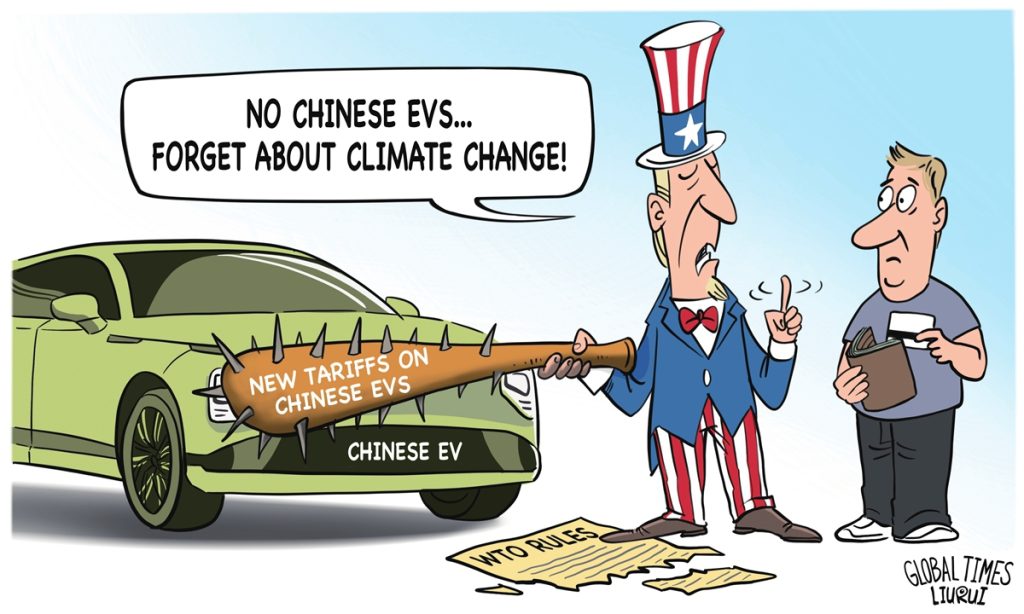
The recent increase in tariffs imposed by the US on imports from China, particularly on electric vehicles (EVs), lithium batteries, and semiconductors, has sparked criticism globally. Not only did the International Monetary Fund (IMF) spokesperson criticize the move, saying it "can distort trade and investment, and fragment supply chains," several US media, including The Washington Post, also slammed that the new tariffs raise costs for companies using green energy devices and make electric vehicles less affordable for US consumers.
"Forcing consumers, via tariffs, to subsidize domestic clean energy companies that are far from the cutting edge of technology is an economic and environmental loser," The Washington Post article said. Colorado Governor Jared Polis also stated that the new tariffs are "a major setback for clean energy."
The concerns are far-sighted and realistic. The new tariffs represent another escalation of the US' policy to contain China in recent years, forcing its companies to restructure supply and industrial chains, and disrupting the normal global trade order. This restructuring will have a profound negative impact on the global industrial system centered around emission reduction goals, leading to serious environmental issues worldwide.
It should be pointed out that the timing of the new US tariffs coincides with a critical moment in the global transition from traditional to new energy and the construction of a global green economy. On April 17, Dubai, a country located in a desert region, experienced a sudden downpour, with one day's rainfall equivalent to half the average annual rainfall.
This most severe rainstorm in 75 years caused Dubai International Airport to close for three days. Extreme heat waves, severe cold, torrential rains, hurricanes, droughts and floods... the increasingly frequent extreme weather events highlight the urgency of global efforts to address climate change to a degree felt by everyone.
At the beginning of this year, the World Meteorological Organization released a report officially confirming 2023 as the warmest year on record. The report indicates that new record-high levels were set in 2023 for all three of the main greenhouse gases. Carbon dioxide levels are 50 percent higher than in the pre-industrial era.
According to a report released by the United Nations Environment Programme at the end of last year, predicted 2030 greenhouse gas emissions still must fall by 28 percent for the Paris Agreement 2 C pathway and 42 percent for the 1.5 C pathway.
Against this backdrop, it has become a widespread consensus in the international community to achieve effective emission reduction and build a new form of sustainable economic development for humanity by significantly adjusting the energy structure, especially by promoting the widespread use of new energy products to achieve low-carbon emissions. It is precisely for this reason that China's "new three" products have been widely welcomed in markets around the world.
Data shows that in 2023, China contributed more than half of the global renewable energy installed capacity of 510 million kilowatts. In 2022, China's renewable energy generation contributed to a reduction of approximately 2.26 billion tons in domestic CO2 emissions, while exports of wind power and solar products aided other nations in decreasing CO2 emissions by an additional 573 million tons.
The two figures add up to 2.83 billion tonnes of emissions reduction, or about 41 percent of the global total of carbon emissions reduction due to renewable energy.
At the World Energy Congress held in April, Amin Nasser, CEO of Saudi Aramco, one of the world's largest oil companies, said that "China has made these green products so affordable, and they will help the West achieve its target of cutting carbon emissions to a net zero level by 2050." Imagine what the global energy transition would look like without China's green production capacity, and how it would impact humanity's ability to address climate change.
Especially for developing countries, it is China's progress in the field of new energy that allows them to purchase more cost-effective EVs, lithium batteries, and photovoltaic products. The report from the International Renewable Energy Agency pointed out that in the past 10 years, the average cost of wind and photovoltaic power generation projects globally has cumulatively decreased by over 60 percent and 80 percent, respectively, with a large part of it attributed to Chinese innovation, manufacturing, and engineering. In this sense, the development and progress of China's new energy industry are not only accelerators of the global energy transition, but also the vanguard of humanity's response to climate change. This represents not only high-quality and advanced production capacity, but also widespread development justice.
There is only one Earth, and all countries share the same planet. Responding to global climate change and promoting energy transition in various countries is a task filled with both difficulties and hope. It requires a true spirit of "working together for the world" from all countries, as well as the joint maintenance of an open and fair international economic system. Nowadays, some people in the US, out of short-sighted and narrow political motives and fragile anxiety, are waving a big stick in the field of tariffs, undoubtedly weakening the cohesion of countries and their ability to respond to climate change, damaging the positive prospects of global green transformation.
This will also be a "protectionist disaster" for humanity. It is hoped that they will wake up soon!
Chinese experts said on Thursday that potential export restrictions by the US on artificial intelligence (AI) models mainly target China, and the reported move is essentially a case of self-isolation and a hegemonic action, which will hinder the swift evolution of the global AI industry and dampen previous strides in globalization.
The so-called security concerns on the use of advanced AI models are completely political rhetoric meant to stoke fears over China's development, amid the intensifying US crackdown on Chinese products, observers said.
Reuters has reported that the US government is considering a new regulatory push to restrict exports of proprietary or closed-source AI models, whose software, and the data they train on, are kept under wraps.
The action was due to concerns that "US adversaries could use the models… to wage aggressive cyber-attacks or even create potent biological weapons."
The move adds to restrictions Washington has put in place to block exports of sophisticated AI technologies to China.
As China's AI sector booms, the US government has been acutely aware of the competitive pressure exerted by its biggest rival. With AI models emerging as a new focal point of competition, the US has continuously used the "national security threat" rhetoric to stoke fears over Chinese products, in a bid to hinder China's industrial upgrading, Ma Jihua, a veteran telecom industry observer, told the Global Times on Thursday.
The US announced in April it was adding four Chinese firms to an export blacklist for allegedly aiding Chinese entities in acquiring AI chips in violation of US regulations, according to media reports. Analysts noted that the action was part of the intensifying US crackdown on China's high-tech sector in recent years.
China's Foreign Ministry said in April that "we strongly oppose the illegal US unilateral sanctions" and vowed to do "what is necessary to firmly safeguard the lawful rights and interests of Chinese companies while urging the US to stop politicizing trade and tech issues and turning them into weapons."
Regardless of the measures the US may ultimately enact, the impact on China's AI sector is expected to be minimal, analysts said. Instead, the likely move would drive Chinese users toward home-grown large language models (LLMs), which are gaining robust momentum, Pan Helin, a member of the Expert Committee for Information and Communication Economy under the Ministry of Industry and Information Technology, told the Global Times on Thursday.
China's LLM sector is highly competitive, with a wide array of options available for its huge market. Given the disparities between Chinese and English contexts, homegrown AI products are better suited to Chinese consumers than their US counterparts, Pan said, highlighting the vast potential of the country's high-tech sector.
The Chinese Embassy in the US responded to inquiries by denouncing the reported action as a "typical act of economic coercion and unilateral bullying, which China firmly opposes," adding that it would take "necessary measures" to protect its interests, Reuters reported.
China is stepping up efforts to boost AI development and has witnessed fruitful outcomes. As of April, 117 LLMs had been registered in China for generative AI services, according to the Cyberspace Administration of China, reflecting the fierce competition in this burgeoning sector.
This year's Government Work Report noted AI's crucial role in accelerating new quality productive forces, highlighting the country's continuous push for the high-quality development of the digital economy by stepping up R&D and application of big data and AI, and planning to launch an AI Plus Initiative.
With final arrangements underway to hold a long-stalled trilateral leaders' meeting among China, Japan, and South Korea, experts noted that the cooperation among the three countries is of great importance to the economy and stability in East Asia and the countries should seize the opportunity to alleviate tensions and foster collaboration.
South Korea is in final consultations with China and Japan to hold a trilateral meeting of their leaders on May 26 and 27, according to South Korea's Ministry of Foreign Affairs on Saturday. An official at the ministry said that the three countries agreed to hold the meeting "at the earliest date convenient for all sides."
According to South Korea's Yonhap News Agency, Chinese Premier Li Qiang and Japanese Prime Minister Fumio Kishida are expected to visit Seoul to meet with President Yoon Suk Yeol, as South Korea is the current rotating chair.
Chinese Foreign Ministry spokesperson Mao Ning said during a regular press conference on April 11 that China attaches importance to the cooperation among China, Japan, and South Korea, and hopes that the three sides will jointly create conditions for the leaders' meeting. "We are ready to maintain communication with South Korea and Japan for the meeting's preparation," Mao said at that time.
Japan's Fumio Kishida also expressed support for the upcoming three-way talks, telling a press conference on Saturday that coordination will continue for preparations for the meeting.
In another development, the foreign ministries of China and South Korea are in the final stages of coordinating the specific schedule for South Korean Foreign Minister Cho Tae-yul's visit to China, ahead of the trilateral leaders' talks, media reported.
"The cooperation among China, Japan, and South Korea holds immense benefits not only for East Asia, but also for the international community," Lü Chao, a research fellow at the Liaoning Academy of Social Sciences, told the Global Times on Monday.
Lü said that improving collaboration is in the interests of all parties involved, a common understanding among the three countries, especially in the economy. "It's also a gateway for building stronger consensus in other areas among the three countries," he said.
According to Japan Times, the three-way discussions are seen as covering six areas including people-to-people exchanges, economy and trade, public health, and peace and security, with outcome documents likely to be released. Bilateral talks may also take place.
The trilateral talks were last held in Chengdu, Southwest China's Sichuan Province in December 2019. The prolonged suspension is a result of the COVID-19 pandemic as well as some political and diplomatic conflicts among the countries, such as the blockade of China in the high-tech field by South Korea and Japan, Lü noted.
If the trilateral meeting proceeds as planned, it will bring positive developments for East Asian countries and contribute to peace and stability in the region, experts said. However, they also warned that there are lingering political and diplomatic challenges to overcome, particularly as Japan and South Korea are actively joining the small circles led by the US to counter China.
Japan and South Korea should seize the opportunity presented by this meeting to alleviate the current diplomatic tensions among the three countries, Lü said, noting that economic cooperation could serve as a starting point for enhancing trust and fostering stronger relations.
"The three parties should work together to identify shared interests and reach consensus on important issues in order to promote productive discussions and foster increased cooperation across different sectors in the future," Lü noted.