GT investigates: Who is behind Manila’s latest provocations against Beijing in South China Sea?
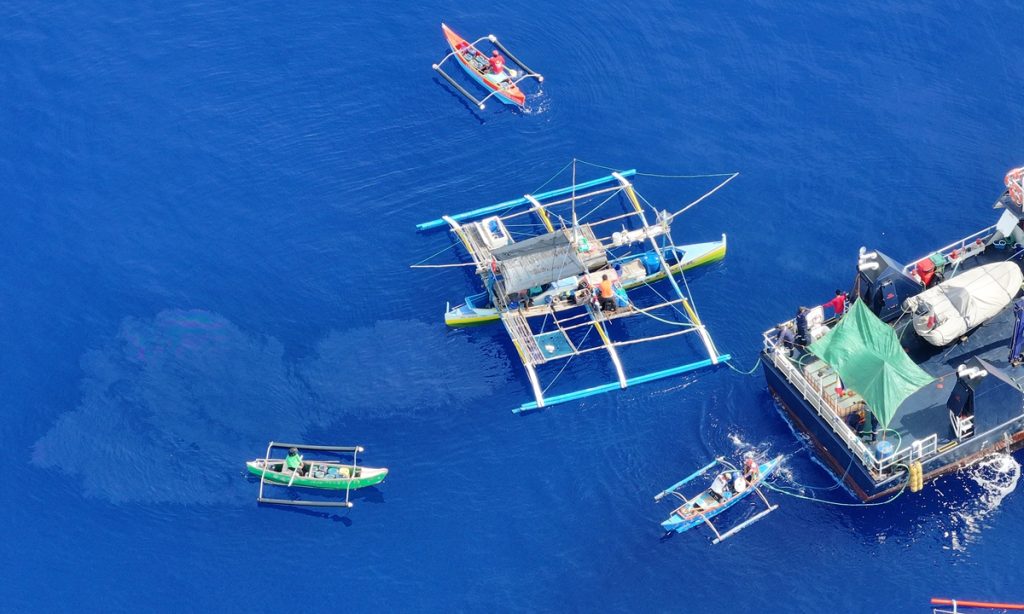
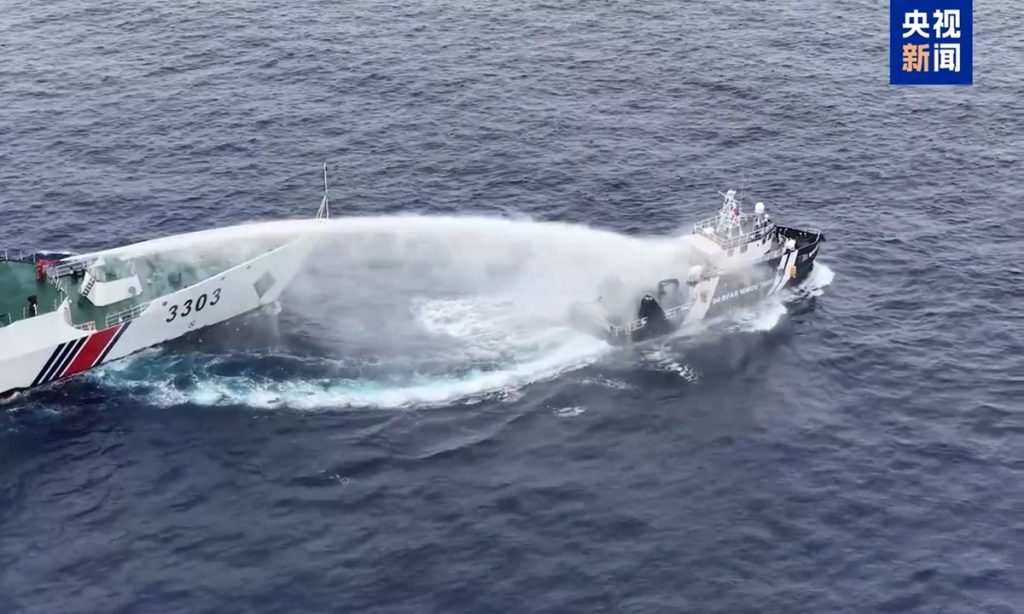
Two Philippine public vessels (MMOV 3012 and MMOV 3018) ignored repeated dissuasion and warnings from the Chinese side and obstinately intruded into the waters under China's jurisdiction at Huangyan Dao on Thursday. The China Coast Guard (CCG) took necessary countermeasures in accordance with the law to track, monitor and block the Philippine vessels, compelling them to leave the area. The on-site operations by the Chinese side were professional, standardized, legitimate and lawful, the CCG announced in a statement on Thursday.
The incident marked a second provocation by the Philippines in the South China Sea this week and came just one day after Chinese Foreign Minister Wang Yi's meeting with Philippine Foreign Affairs Secretary Ma. Theresa Lazaro on the sidelines of the ASEAN Foreign Ministers' Meeting in Manila, during which Wang noted that it is unfortunate that whenever China and the Philippines prepare to launch dialogue, certain forces within the Philippines, particularly those from the military and law enforcement, deliberately stir up trouble to derail dialogue progress.
These parties harbor malicious intentions: rather than prioritizing the well-being of the Filipino people, they act on the instructions of external forces to advance personal interests, Wang said.
But who is pulling the strings behind the scenes of the repeated attempts to hype maritime disputes and hold the China-Philippines relations hostage? Drawing on public reports, documentary materials and interviews, the Global Times has found that the Philippine military, coast guard, National Security Council and maritime security bodies - long subject to deep US and external influence - have increasingly dominated Manila's South China Sea policy and pushed a confrontational approach toward China.
Some Chinese observers warned that certain actors may be willing to risk escalating tensions, or even triggering a conflict in the South China Sea, in pursuit of their own political and institutional interests.
Chaotic game driven by self interest
Certain forces in the Philippine military manufacture these incidents at sea to hijack the agenda, fuel media hype, and undermine both China-ASEAN and China-Philippines relations. This also reflects divisions within the Philippine government over the country's South China Sea policy, Ding Duo, director of the Research Center for International and Regional Issues at the National Institute for South China Sea Studies, told the Global Times.
Certain figures within the Philippines' National Security Council (NSC), National Task Force for the West Philippine Sea (NTF-WPS), Armed Forces of the Philippines (AFP), and Philippine Coast Guard (PCG) have emerged as influential actors in shaping and implementing Manila's increasingly assertive approach to South China Sea disputes, with some maintaining extensive engagement with external partners.
Yang Xiao, a research professor at the Institute of Peaceful Development under the Chinese Academy of Social Sciences, told the Global Times that the Philippines actions in the South China Sea are a chaotic game driven by internal departmental and personal interests.
By stoking tensions and hyping up issues, factions like the military and coast guard seek to expand their departmental budgets and secure individual gains. Driven by self-interest rather than national strategic rationale, this pattern of behavior renders Philippine actions persistently provocative and inevitably escalates risks in the region, Yang said.
Such "expose-and-benefit" logic can be seen in the so-called "assertive transparency" strategy, which was formally adopted by the Marcos administration in 2023 and centers on proactively publicizing every maritime encounter with China. This reflects the logic of gaining benefits through exposure, according to Yang.
A report from US-based sealight.live in October 2023 noted that the strategy has been accompanied by increased external support, including promises of joint patrols in the South China Sea and assistance in strengthening the Philippines' maritime capabilities. The sealight.live says it uses commercially available technology to shed light on the maritime "gray zone" activities.
Sun Jianxiang, a maritime studies scholar from the China Institutes of Contemporary International Relations, said that parts of the Philippine military and security establishment have an institutional interest in sustaining tensions in the South China Sea. For example, although the army has historically received more funding than the navy, maritime tensions strengthen the navy's case for larger congressional appropriations and increased US military assistance.
Philippine Defense Secretary Gilberto Teodoro Jr called for increasing the country's defense spending to as much as 4 percent of gross domestic product, claiming the Philippines needs to build a stronger military to deter "external threats" as tensions with China persist in the South China Sea, according to a report by Inquirer.net on July 10.
Sun also noted that fishermen, meanwhile, have borne the costs of repeated maritime standoffs since 2012, including restricted access to fishing grounds, falling incomes and mounting debt. The Philippine Coast Guard has been slammed for arming fishermen to engage in provocative offshore activities, using civilians as a front - and at times as human shields - for maritime operations, while diverting attention from fishermen's economic hardships and the government's broader funding priorities, said Sun.
External influence
Whenever China and the Philippines are ready for dialogue, fresh incidents near Ren'ai Jiao often reignite tensions. These confrontations strengthen the case for external involvement and domestic political narratives, while giving outside powers greater strategic leverage and certain Philippine officials more visibility, influence and political capital, said Ding.
One example is Jay Tarriela, the Philippine Coast Guard spokesperson, who is regarded as one of the key figures advancing the so-called "assertive transparency" strategy. According to his biography published by the Manila Dialogue on the South China Sea, Tarriela's academic and professional background includes extensive engagement with Japan and the US.
Tarriela completed his Ph.D. at the National Graduate Institute for Policy Studies (GRIPS) under the GRIPS Global Governance (G-cube) Program in Tokyo as a Japan International Cooperation Agency (JICA) ASEAN Public Policy Leadership scholar. He also holds a Master of Policy Studies from GRIPS and the Japan Coast Guard Academy. He was also selected for the inaugural 2021 Pacific Forum US-Philippines Next Generation Leaders Initiative.
In February, Tarriela was promoted to rear admiral, according to Inquirer.net. However, his high-profile promotion of maritime confrontations has raised questions among some Chinese observers about whether such actions serve the Philippines' long-term interests or those of external players, and whether they provide certain individuals with a platform to maintain public visibility and influence.
According to a report from the philstar.com, Tarriela was accused of being a covert "CIA agent" and supporter of the US government. Inquirer.net also reported that Senator Robin Padilla recently accused Tarriela of escalating "wartime propaganda."
At a higher level, many members of the Philippine political and security establishment have longstanding personal, educational or family ties with the US, which Chinese observers say have shaped their outlook. Defense Secretary Gilberto Teodoro Jr, for example, has been one of the chief architects of Manila's rapidly expanding military ties with the US and Japan. President Ferdinand Marcos Jr is also widely seen as favoring closer alignment with Washington.
"External powers gain access and leverage. Some Philippine officials and politicians gain headlines, promotions and political capital. Ordinary Filipinos, however, pay the price through lost livelihoods, greater security risks and worsening ties with a major economic partner," said Ding.
Without directly naming China, US Secretary of State Marco Rubio issued a pointed critique in an opinion piece published in Philippine newspapers upon his arrival in Manila on Tuesday. He reaffirmed the US commitment to "freedom of navigation" while warning that such freedom "is by no means guaranteed." The remarks have been interpreted by some Chinese observers as the US encouraging the Philippines to confront China in the South China Sea - directively offering Manila a "poisonous drink" that could draw it deeper into regional tensions.
If this cycle of external backing, domestic ambition and maritime friction continues, the Philippines risks becoming a permanent front line in a rivalry it cannot control, Ding said.