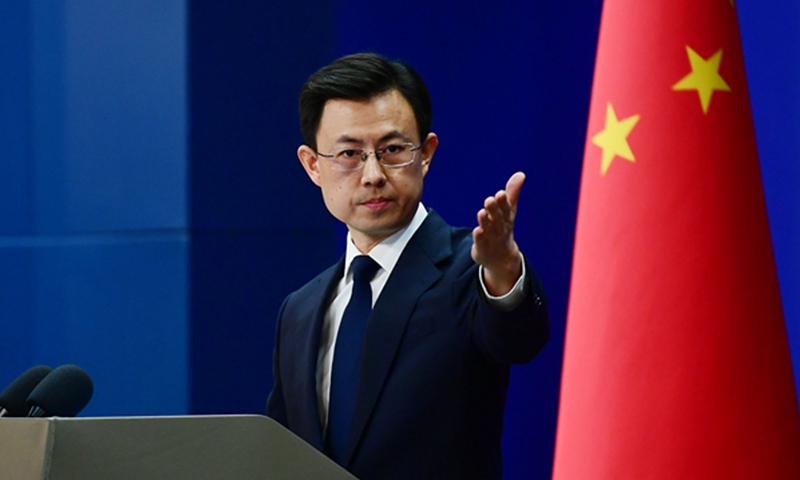
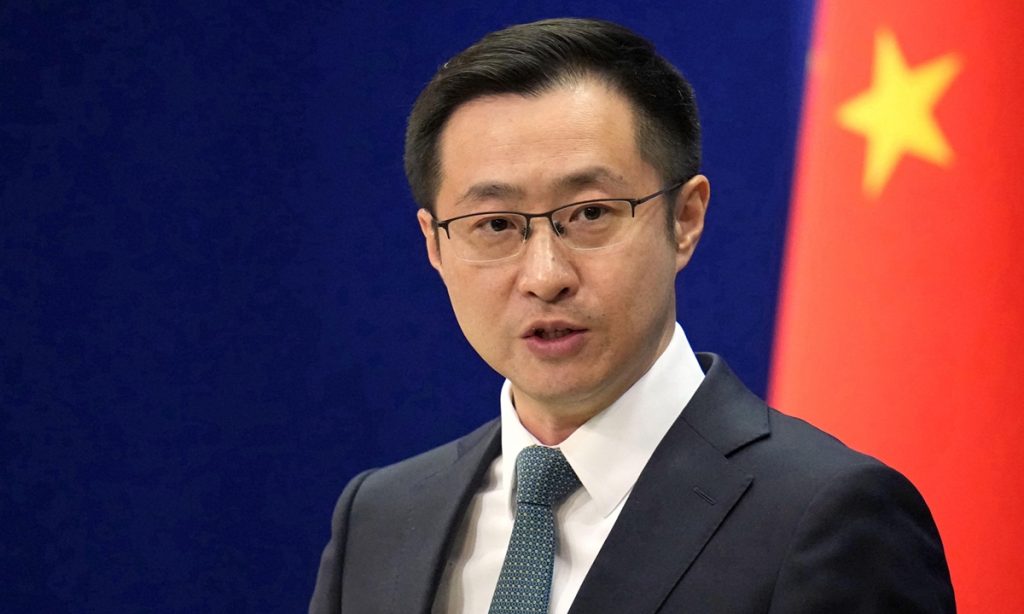
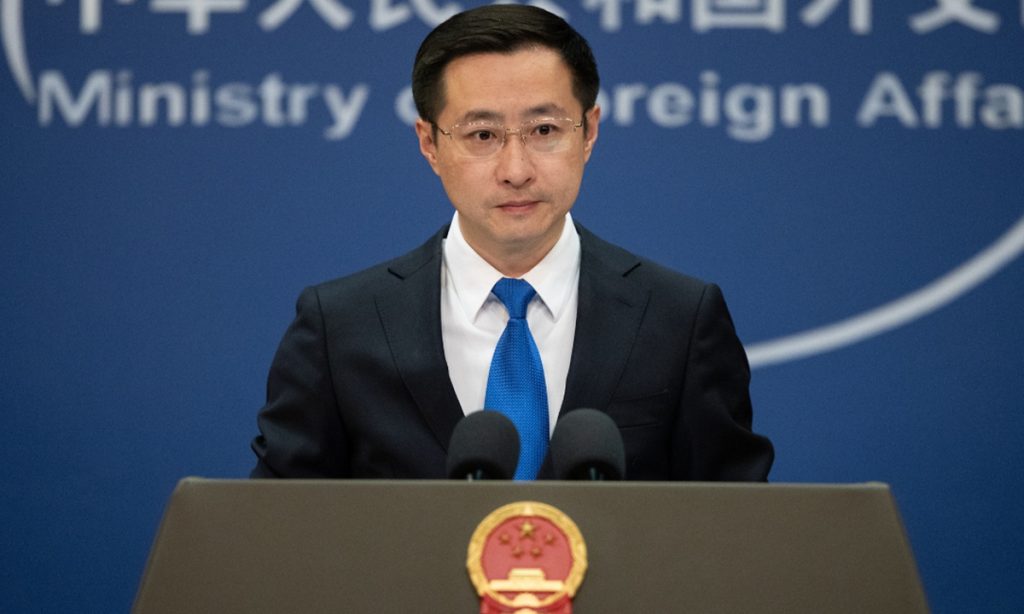
When asked by a foreign reporter to comment on the US Department of the Treasury's announcement of sanctions against nine individuals and entities from the Chinese mainland and Hong Kong Special Administrative Region (HKSAR) for allegedly providing support to the Iranian military in procuring weapons, Chinese Foreign Ministry spokesperson Lin Jian said on Friday that "we will take all necessary measures to firmly safeguard the legitimate rights and interests of Chinese companies and nationals."
Lin added that "as we have repeatedly made clear, China firmly opposes illegal unilateral sanctions that have no basis in international law or are not authorized by the UN Security Council."
General Secretary of the Communist Party of China Central Committee and Chinese President Xi Jinping held talks with General Secretary of the Lao People's Revolutionary Party Central Committee and Lao President Thongloun Sisoulith in Beijing on Friday.
Chinese Vice President Han Zheng met with Belarusian First Deputy Prime Minister Nikolai Snopkov in Minsk on Saturday.
Han said China and Belarus are good friends and good partners. China is ready to work with Belarus to implement the important consensus reached by the two heads of state, enhance strategic mutual trust and deepen mutually beneficial cooperation to bring more benefits to the two peoples.
Noting China and Belarus enjoy strong economic complementarity and broad prospects for cooperation, Han said China is willing to strengthen the alignment of development strategies with Belarus and continue to open up new space for win-win cooperation.
He called for joint efforts to build the China-Belarus Industrial Park into an international industrial hub, welcomed more high-quality Belarusian products to the Chinese market, and urged both sides to step up youth exchanges to foster closer ties between the two peoples.
Snopkov said Belarus admires China's remarkable development achievements, and firmly believes the Chinese modernization will greatly contribute to world peace, development and common prosperity.
Belarus will always be a trustworthy and reliable strategic partner of China, he said, adding that his country is willing to work with China to implement the important consensus reached by the two heads of state and fully leverage existing bilateral cooperation mechanisms to enhance people-to-people exchanges and expand industrial cooperation.
Young people across the Shanghai Cooperation Organisation (SCO) widely endorse the concepts and actions of the SCO, highly appreciate its positive role in global governance and hold high expectations for deepening cooperation across various fields among member states, according to a report released in Bishkek, Kyrgyzstan, on May 27.
The report on interest trends among youth in SCO member states was jointly released by the Secretariat of the Belt and Road News Network (BRNN) and the Global Times at the 2026 China-Kyrgyzstan Media Cooperation Forum held in Bishkek. It is based on a 2025 survey of 10 official SCO member states, as well as data from Global Public Opinion. Focusing on youth perceptions and emerging trends, the report finds that young people are highly invested in employment, entrepreneurship, education, cultural ties, and global partnerships.
The findings show that young respondents strongly identify with the principles of the Shanghai Spirit, featuring mutual trust, mutual benefit, equality, consultation, respect for diverse civilizations and the pursuit of common development. More than 80 percent of respondents believe that development cooperation within the SCO framework has brought tangible benefits to their own countries. Among them, 72 percent cited "promoting high-quality development in home countries," and 62 percent pointed to "bringing more international cooperation and development opportunities." Over 80 percent also affirmed the SCO's positive role in global governance.
China, as a founding member of the SCO, has consistently upheld and acted on the Shanghai Spirit by deepening practical cooperation in various fields with other member states and promoting shared development. The survey shows that among young respondents in SCO countries other than China, more than 90 percent of respondents believe that cooperation with China can positively impact their own country's development and modernization.
More than 90 percent of respodents said that China's development experience in multiple areas is worth learning from. These figures reflect a strong desire among young people across the SCO to deepen cooperation with China and benefit from shared development opportunities.
People-to-people exchanges are one of the most-watched areas of cooperation for young people in SCO member states. More than 90 percent of respondents said they look forward to future SCO cultural and exchange programs and activities. Among the most popular were "youth exchanges," "university/student exchanges," "foreign language learning," and "vocational training." The report concludes that young people are not only interested in macro-level cooperation between countries, but also place great importance on the real-world opportunities brought by education, skills and cross-cultural communication.
Moreover, the concerns of young people in SCO member states show clear contemporary characteristics. Hot topics such as AI, skills development and cultural consumption have become key indicators of trends in employment, education and cultural life. According to the survey, in 2025, media coverage of topics related to "youth," "employment" and "entrepreneurship" in SCO member states saw a 141 percent year-on-year increase in mentions of AI. AI is emerging as an important driver for young people to explore innovation and expand their career opportunities. In education, young people place a high priority on digital skills, practical skills and innovation capabilities, with a clear trend toward digital, remote and cross-cultural learning. At the same time, young respondents maintain a strong sense of their own cultural identity and are developing a cultural awareness that is both locally rooted and globally minded.
Youth represent the future of the SCO and are an important force driving regional cooperation and shared development. The report provides a concentrated picture of the common understandings, real concerns and development expectations of young people in SCO member states, offering a valuable public opinion reference for deepening youth cooperation. Despite a complex and changing international environment, young people in the SCO remain positive about multilateral cooperation and shared development - a sign of the deep youth base and broad prospects for SCO cooperation.
General Secretary of the Lao People's Revolutionary Party Central Committee and Lao President Thongloun Sisoulith arrives in Beijing, capital of China, June 4, 2026. Thongloun is in China for a five-day state visit. (Photo: Xinhua)
An article by Xi Jinping, general secretary of the Communist Party of China (CPC) Central Committee, on deeply advancing the Party's self-reform will be published on Monday.
The article by Xi, also Chinese president and chairman of the Central Military Commission, will be published in this year's 24th issue of the Qiushi Journal, a flagship magazine of the CPC Central Committee.
China announced on Tuesday a significant relaxation of its visa-free transit policy, extending the permitted stay for eligible foreign travelers from the original 72 and 144 hours to 240 hours, or 10 days.
The US insisted on arranging Lai's "transit" to offer platform for "Taiwan independence" separatist activities, seriously violating the one-China principle and the three China-US Joint Communiqués, undermining China's sovereignty and territorial integrity, and sending a seriously wrong signal to the "Taiwan independence" separatist forces. China strongly protests this and has lodged a stern representation with the US, Chinese Foreign Ministry spokesperson Lin Jian said at a press conference on Friday.
Taiwan regional Leader Lai Ching-te is reportedly completing "transiting" through Hawaii and Guam and is scheduled to return to the island on Friday.
Lin said the Taiwan question is the primary, non-negotiable red line in China-US relations. The actions of "Taiwan independence" are incompatible with peace and stability in the Taiwan Straits.
China urges the US to adhere to the one-China principle and the three China-US Joint Communiqués, honor US leaders' commitments not to support "Taiwan independence," cease official exchanges between the US and the island of Taiwan, stop hollowing out or undermining the one-China principle, and cease any form of support or tolerance for "Taiwan independence" separatist forces and their activities and take concrete actions to stabilize China-US relations and maintain peace in the Taiwan Straits, said the spokesperson.
Any attempt to rely on the US for "independence" will hit a wall, and any efforts to use Taiwan island to contain China are bound to fail, Lin said.
In response to another inquiry on whether the mainland is planning to conduct more military exercises surrounding Taiwan island as Taiwan regional leader Lai Ching-te has completed "transiting" through Hawaii and Guam, Chinese Foreign Ministry spokesperson Lin Jian said the Taiwan question is at the core of China's core interests and the foremost, non-negotiable red line in China-US relations. China's determination to defend its national sovereignty and territorial integrity is unwavering.
Previously some Taiwan local media claimed that the mainland military is poised to "encircle Taiwan proper in military exercise 'Joint Sword-2024C,'" as Lai returns from his visit to "diplomatic allies" in the Pacific via "transit" through Hawaii and Guam.
Meanwhile, speaking to reporters in Palau on Friday, Lai claimed that the two sides of the Taiwan Straits are "not subordinate to each other," which Lin also refuted on Friday, saying that the separatist activities of the "Taiwan independence" forces and the connivance and support from external forces are the greatest threats to peace and stability in the Taiwan Straits.
Lai and the DPP authorities have consistently used various pretexts to promote "Taiwan independence" separatism. Regardless of what they say or do, they cannot change the fact that Taiwan is a part of China, nor can they stop the historical trend that China will be and must be reunified. The attempt to rely on external forces for independence is doomed to fail, Lin said.
Also on Friday, Lai claimed that he is confident in deepening cooperation with the next Trump administration in the US. The day before, he had a phone call with US House of Representatives Speaker Mike Johnson.
In response, Lin said that China has repeatedly stated its firm position on this matter. We urge the US to recognize the "Taiwan independence" separatist nature of Lai Ching-te and the DPP authorities, and the serious harm that "Taiwan independence" separatist actions pose to peace and stability in the Taiwan Straits.
The US should adhere to the one-China principle and the three China-US Joint Communiqués, stop interfering in Taiwan affairs, stop meddling in China's internal affairs, and cease supporting or conniving "Taiwan independence" separatist forces, said Lin.
Pangolin decoction pieces remain ineligible for medical insurance coverage and drugs containing pangolin ingredients must not be newly included in medical insurance coverage, according to a recent notice by three central departments in China to strengthen pangolin protection and management efforts and enhance their conservation.
The notice, jointly released by the National Forestry and Grassland Administration, the National Administration of Traditional Chinese Medicine, and the National Medical Products Administration, was made public through the National Medical Products Administration's official WeChat account on Wednesday.
The Chinese government attaches great importance to pangolin conservation. On June 3, 2020, all species of pangolins were elevated to the status of nationally protected wildlife. Pangolin scales are seen in traditional Chinese medicine to promote lactation and impotence.
The notice calls for strengthening the National Forestry and Grassland Administration's pangolin protection and research center, establishing pangolin artificial breeding bases and germplasm resource banks, jointly tackling key technologies for pangolin artificial breeding, and achieving significant progress in building pangolin breeding populations.
Research institutions, hospitals, and pharmaceutical companies are encouraged and supported to jointly carry out research on substitutes for pangolin scales, the notice reads.
China's efforts in protecting pangolins have been consistent. The newly-released documents highlight the Chinese government's intention to seek alternatives of pangolins in the use of medicine, Sun Quanhui, a scientist from the World Animal Protection organization, told the Global Times on Thursday.
Whether for wild animal protection or industrial development, development of alternatives to pangolin scales is a rational choice, Sun said. He further said that scientific teams in China have been trialing synthetic alternative akin to pangolin scales, by precisely understanding the substances of pangolin. If their research goes well, we expect to see pangolin scale substitute in near future.
According to the notice, supervision will be strengthened to strictly regulate the use of pangolin scales in medicine. Following the principle of "conserving resources and being strict and prudent," strict oversight of pangolin scale use in medicine will be enforced, with efforts to minimize consumption.
The three administrations requested provincial-level forestry and grassland, traditional Chinese medicine, and medical products administration departments jointly conduct a survey on the utilization of pangolins to grasp the situation of pangolin artificial breeding institutions, pangolin scale inventories, and the use, purchase, and sale of pangolin scales by traditional Chinese medicine hospitals and pharmaceutical production enterprises in the past three years in their respective provinces.
The annual consumption of pangolin scales will be strictly controlled, in principle, at around 1 ton, the notice reads.
Provincial-level forestry and grassland departments are also requested to strengthen supervision and verification of legal holders of pangolin scales inventories in their provinces and update the inventory of pangolin scales based on administrative licensing in a timely manner.
For provincial traditional Chinese medicine administration and medical products supervision departments, they should strictly supervise hospitals and pharmaceutical enterprises using pangolin scales within their jurisdictions. All units will seriously handle violations of laws and regulations in accordance with the law to resolutely stop the abuse of pangolin scales, the notice says.
Pangolin scales and their products confiscated by law enforcement are restricted to non-commercial activities such as scientific research, judicial law enforcement, and public welfare promotion, according to the notice.
The use of pangolin scales and their products from other illegal or unknown sources is strictly prohibited, it states.
The commercial import and export of pangolins and their products remain prohibited, the notice reads.
At the invitation of Russia's State Atomic Energy Corporation Rosatom, China's Minister of Transport Liu Wei attended the first meeting of the subcommittee on Arctic shipping routes cooperation under the committee for regular meetings between Chinese and Russian heads of government, where he held talks with the subcommittee's Russian Chairman, Alexey Likhachev, and conducted working visit, on Sunday and Monday, according to China's Ministry of Transport's official WeChat account on Tuesday.
The first meeting of the subcommittee on Arctic shipping routes was held in Saint Petersburg on Monday. Liu pointed out that the subcommittee on Arctic shipping routes is a new working mechanism established under the committee for regular meetings between Chinese and Russian heads of government. It is an important platform for promoting the cooperation and development of Arctic shipping routes and an important channel for sharing experiences and seeking mutual development.
During this meeting, the two sides reached a series of important consensus on the mechanism, structure of the subcommittee and cooperation objectives, achieving fruitful results. China is willing to work with Russia to fully utilize the subcommittee's role, enhance the competitiveness of Arctic shipping, jointly ensure Arctic navigation safety, and promote new progress in polar shipbuilding, implementing the consensus of the two countries' leaders through concrete actions.
Alexey Likhachev, who is also director general of the Rosatom, noted that the establishment of the subcommittee on Arctic shipping routes is of historical significance, coinciding with the 75th anniversary of diplomatic relations between Russia and China. Rosatom is willing to deepen cooperation with the Chinese Ministry of Transport in various fields such as Arctic shipping, safety, and polar shipbuilding technology, and actively promote China-Russia Arctic shipping routes cooperation to new highs.
The meeting heard reports from three working groups under the subcommittee: shipping development, navigation safety, and polar ship technology and construction. It also approved the regulations for the subcommittee on Arctic shipping routes, signed the meeting minutes, and clarified the relevant consensuses and key tasks for 2025.