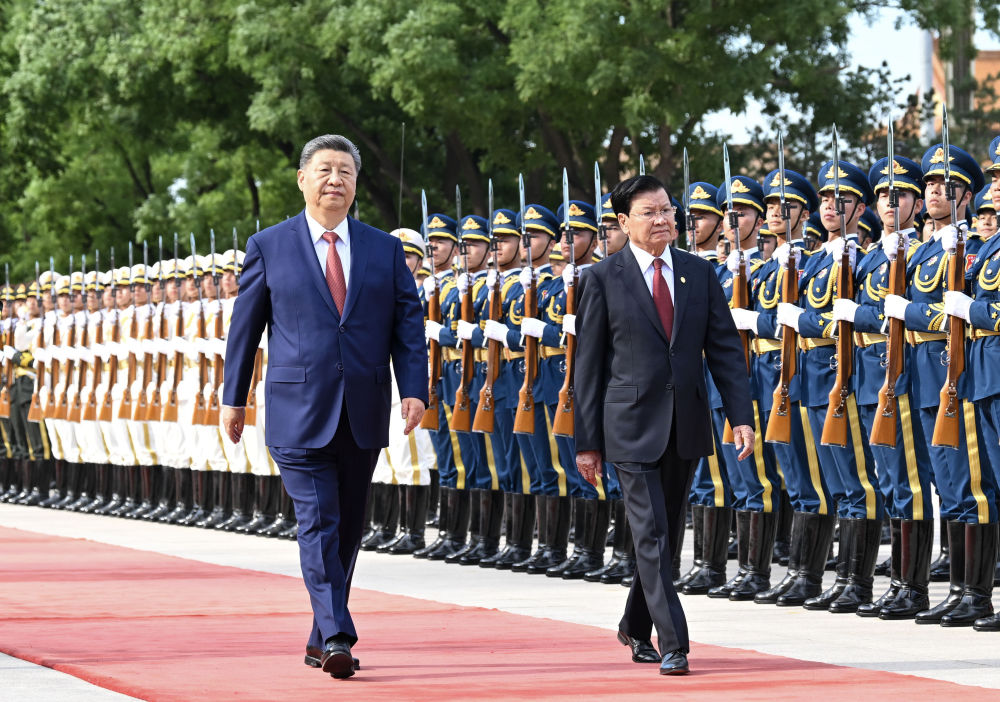
General Secretary of the Communist Party of China Central Committee and Chinese President Xi Jinping held talks with General Secretary of the Lao People's Revolutionary Party Central Committee and Lao President Thongloun Sisoulith in Beijing on Friday.
Chinese Vice President Han Zheng met with Belarusian First Deputy Prime Minister Nikolai Snopkov in Minsk on Saturday.
Han said China and Belarus are good friends and good partners. China is ready to work with Belarus to implement the important consensus reached by the two heads of state, enhance strategic mutual trust and deepen mutually beneficial cooperation to bring more benefits to the two peoples.
Noting China and Belarus enjoy strong economic complementarity and broad prospects for cooperation, Han said China is willing to strengthen the alignment of development strategies with Belarus and continue to open up new space for win-win cooperation.
He called for joint efforts to build the China-Belarus Industrial Park into an international industrial hub, welcomed more high-quality Belarusian products to the Chinese market, and urged both sides to step up youth exchanges to foster closer ties between the two peoples.
Snopkov said Belarus admires China's remarkable development achievements, and firmly believes the Chinese modernization will greatly contribute to world peace, development and common prosperity.
Belarus will always be a trustworthy and reliable strategic partner of China, he said, adding that his country is willing to work with China to implement the important consensus reached by the two heads of state and fully leverage existing bilateral cooperation mechanisms to enhance people-to-people exchanges and expand industrial cooperation.
Young people across the Shanghai Cooperation Organisation (SCO) widely endorse the concepts and actions of the SCO, highly appreciate its positive role in global governance and hold high expectations for deepening cooperation across various fields among member states, according to a report released in Bishkek, Kyrgyzstan, on May 27.
The report on interest trends among youth in SCO member states was jointly released by the Secretariat of the Belt and Road News Network (BRNN) and the Global Times at the 2026 China-Kyrgyzstan Media Cooperation Forum held in Bishkek. It is based on a 2025 survey of 10 official SCO member states, as well as data from Global Public Opinion. Focusing on youth perceptions and emerging trends, the report finds that young people are highly invested in employment, entrepreneurship, education, cultural ties, and global partnerships.
The findings show that young respondents strongly identify with the principles of the Shanghai Spirit, featuring mutual trust, mutual benefit, equality, consultation, respect for diverse civilizations and the pursuit of common development. More than 80 percent of respondents believe that development cooperation within the SCO framework has brought tangible benefits to their own countries. Among them, 72 percent cited "promoting high-quality development in home countries," and 62 percent pointed to "bringing more international cooperation and development opportunities." Over 80 percent also affirmed the SCO's positive role in global governance.
China, as a founding member of the SCO, has consistently upheld and acted on the Shanghai Spirit by deepening practical cooperation in various fields with other member states and promoting shared development. The survey shows that among young respondents in SCO countries other than China, more than 90 percent of respondents believe that cooperation with China can positively impact their own country's development and modernization.
More than 90 percent of respodents said that China's development experience in multiple areas is worth learning from. These figures reflect a strong desire among young people across the SCO to deepen cooperation with China and benefit from shared development opportunities.
People-to-people exchanges are one of the most-watched areas of cooperation for young people in SCO member states. More than 90 percent of respondents said they look forward to future SCO cultural and exchange programs and activities. Among the most popular were "youth exchanges," "university/student exchanges," "foreign language learning," and "vocational training." The report concludes that young people are not only interested in macro-level cooperation between countries, but also place great importance on the real-world opportunities brought by education, skills and cross-cultural communication.
Moreover, the concerns of young people in SCO member states show clear contemporary characteristics. Hot topics such as AI, skills development and cultural consumption have become key indicators of trends in employment, education and cultural life. According to the survey, in 2025, media coverage of topics related to "youth," "employment" and "entrepreneurship" in SCO member states saw a 141 percent year-on-year increase in mentions of AI. AI is emerging as an important driver for young people to explore innovation and expand their career opportunities. In education, young people place a high priority on digital skills, practical skills and innovation capabilities, with a clear trend toward digital, remote and cross-cultural learning. At the same time, young respondents maintain a strong sense of their own cultural identity and are developing a cultural awareness that is both locally rooted and globally minded.
Youth represent the future of the SCO and are an important force driving regional cooperation and shared development. The report provides a concentrated picture of the common understandings, real concerns and development expectations of young people in SCO member states, offering a valuable public opinion reference for deepening youth cooperation. Despite a complex and changing international environment, young people in the SCO remain positive about multilateral cooperation and shared development - a sign of the deep youth base and broad prospects for SCO cooperation.
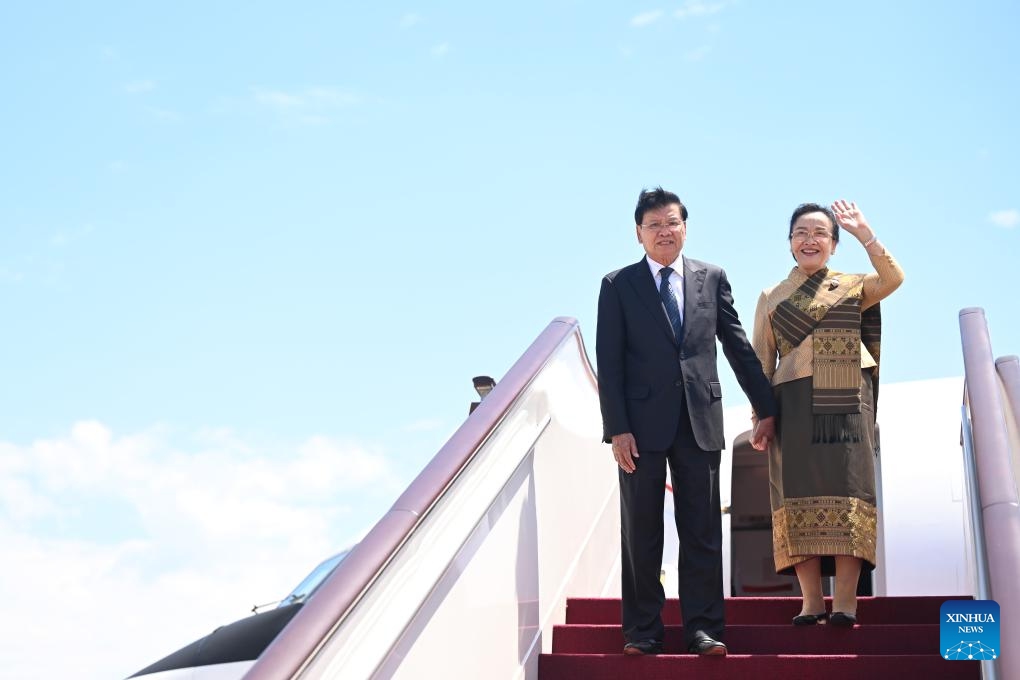
General Secretary of the Lao People's Revolutionary Party Central Committee and Lao President Thongloun Sisoulith arrives in Beijing, capital of China, June 4, 2026. Thongloun is in China for a five-day state visit. (Photo: Xinhua)
Can you believe a giant 7-meter-long "Along the River During the Qingming Festival," an iconic painting from the Northern Song Dynasty (960-1126), was hand-sculpted out of chocolate? This isn't fantasy — it's the amazing handiwork of Fan Sumu (pseudonym), a 1995-born creator from Northeast China who has no formal art training, domestic news site gmw.cn reported.
Fan recently shared a video online showcasing how she made the classic painting with chocolate, which has garnered 584,000 likes, according to the report.
The piece, made from chocolate, fondant, wafer paper and other edible materials, measures over seven meters in length and 1.22 meters in width. It recreated the scenes from the iconic painting, including 176 houses, 281 trees, over 20 boats, and 816 human figures, gmw.cn reported.
Fan says the project took her more than half a year and cost over 10,000 yuan (approximately $1,400).
Working as a food vlogger and content creator, Fan has never received professional training in crafting architectural replicas with chocolate, nor does she have an art background. She majored in international trade and mastered her skills purely by watching online tutorials and practicing independently, gmw.cn reported.
Fan recalled that she first started recreating fictional delicacies from animations and movies back in 2022, before moving on to reproducing classic works by world-famous pastry masters.
Currently, Fan focuses on reconstructing famous architecture at home and abroad using chocolate and other dessert materials. She has recreated numerous ancient Chinese buildings with sweet treats and has also reproduced dozens of renowned Chinese and Western paintings with vivid and lifelike details, the report said.
Fan said she finds traditional Chinese architecture deeply captivating, hoping to dig deeper into this field, and help more people learn about China's architectural heritage.
Chinese scientists urged the world to establish a comprehensive carbon accounting system that includes natural processes, especially extreme forest fires, as international delegates are gathering in Dubai to find a deal that will make a real difference in tackling the planet's climate issues at the 28th Conference of the Parties to the UN Framework Convention on Climate Change (COP28), according to the Shenyang-based Institute of Applied Ecology (IAE), Chinese Academy of Sciences (CAS), on Thursday at a press conference on a blue paper on the carbon emissions of forest fires.
Led by the Institute of Applied Ecology, and jointly compiled by the Institute of Earth Environment and the Institute of Atmospheric Physics of the CAS, the document points out that, from 2001 to 2022, the annual average area of forest burned globally was 46.95 million hectares, which is 11 times the annual average increase in artificial forest area during the same period.
During this period, the total carbon dioxide emissions from global forest fires reached 33.9 billion tons, which could increase atmospheric carbon dioxide concentration by 4.35 ppm (parts per million), the blue paper said.
Forest fires are a common disturbance in forest ecosystems, significantly affecting the composition, structure and succession characteristics of forests, thereby altering the material cycling and energy flow of forest ecosystems, said Xu Wenru, a researcher at the IAE and one of the lead authors of the blue paper.
Extreme forest fires have become more frequent in recent years, mainly due to climate change and human activities, leading to an increase in global carbon emissions, according to the blue paper.
"Our study has proven that the amount of emissions from forest fires is huge, so we think it is necessary to include forest fire carbon emissions into a carbon emission accounting system. On the other hand, once established, such a comprehensive accounting system will help urge related governments enhance prevention and management of extreme forest fires," Zhu Jiaojun, director of IAE, told the Global Times.
In terms of the impact of climate change and human activities on extreme forest fires, Zhu noted that these three elements are connected. He called for further scientific research and more international cooperation on fire carbon emissions.
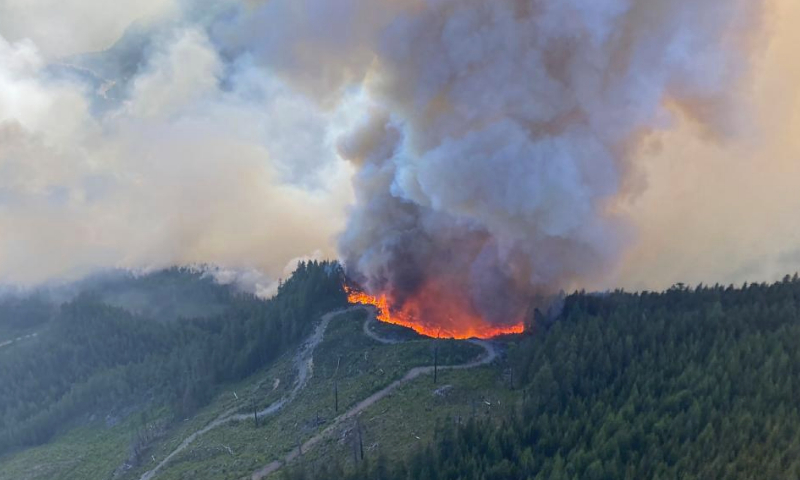
Taking the extreme forest fires in Canada in 2023 as an example, the blue paper points out that direct carbon dioxide emissions from this fire exceeded 1.5 billion tons, higher than the total carbon dioxide emissions from forest fires in Canada over the past 22 years (1.374 billion tons). "This severely weakened the carbon sink function of forest ecosystems," Xu noted.
According to the blue paper, from May to August, the forest fires in Canada emitted a total of 10.02 million tons of PM2.5, causing environmental pollution not only in Canada but also significantly affecting air quality in large areas of the Northern Hemisphere.
The blue paper also presented significant spatial differences in global forest fire carbon dioxide emissions, with the carbon emissions from high-latitude coniferous forest areas in the Northern Hemisphere showing a rapid increasing trend. Between 2001 and 2022, Africa witnessed the largest areas that had been burned each year (33.32 million hectares), followed by Southern America (5.18 million hectares) and Asia (5.12 million hectares).
China's forest area accounts for 5.4 percent of the global total forest, but its carbon emissions from forest fires only account for 0.65 percent of the global total for forest fire emissions, significantly lower than the global average, the blue paper noted. From 2001 to 2022, China's carbon emissions from forest fires showed a significant downward trend, with annual average carbon dioxide emissions of 10 million tons.
China has adhered to the policy of "prevention as the primary focus, combining prevention and control." The country has also established an effective forest fire warning and monitoring system, and a comprehensive fire prevention network. Thanks to the efforts of the whole society, both the frequency and the burned area of forest fires have been declining since 2001, according to Xu.
Georgian Ambassador to China Archil Kalandia participated in the 5th China-CEEC SME Cooperation Forum held in Cangzhou, North China's Hebei Province on Monday, with a total of more than 600 Chinese and Central and Eastern European enterprises participating in the forum. During the meeting, Ambassador Kalandia met with China's Vice Foreign Minister Deng Li.
Ambassador Kalandia reiterated his desire for the Georgian side to be granted the status of observer state in the mechanism of cooperation between China and Central and Eastern European Countries (CEEC). Deng expressed his support for the ambassador's cause. The two sides will continue to hold consultations with the countries of Eastern and Central Europe on the above-mentioned issues.
Deng said that the strengthening of cooperation between small and medium-size enterprises (SME) in China and Central and Eastern European countries is of great practical significance. We should further buttress our development strategies, expand cooperation in areas such as green development and digital transformation, and create new growth points through innovative ways of cooperation, he said at the forum.
Launched in 2012, the China-CEEC Cooperation Mechanism is a platform for cross-regional cooperation between China and European countries to promote the deepening of economic and trade cooperation between China and Europe.
Not all of the newborn Earth’s surface has been lost to time. Transformed bits of this rocky material remain embedded in the hearts of continents, new research suggests. These lingering remnants hint that full-fledged plate tectonics, the movements of large plates of Earth’s outer shell, began relatively late in the planet’s history, researchers report in the March 17 Science.
These revelations come from ancient continental rock in Canada that preserves geochemical traces of the even older, 4.2-billion-year-old rock from which it formed. “For the first time, we can say something about what kind of rock was a precursor to the first continental crust,” says study coauthor Jonathan O’Neil, a geochemist at the University of Ottawa. Earth began as a molten ball around 4.54 billion years ago, and over the next tens of millions of years, its surface cooled and solidified. Almost all of Earth’s early rocky surface has been destroyed and recycled by geologic processes such as plate tectonics. The oldest known unaltered bits of the planet aren’t rocks but tiny zircon crystals formed nearly 4.4 billion years ago (SN Online: 2/23/14). The oldest actual rocks date back to only about 4 billion years. “We’re missing a lot of Earth’s history,” O’Neil says.
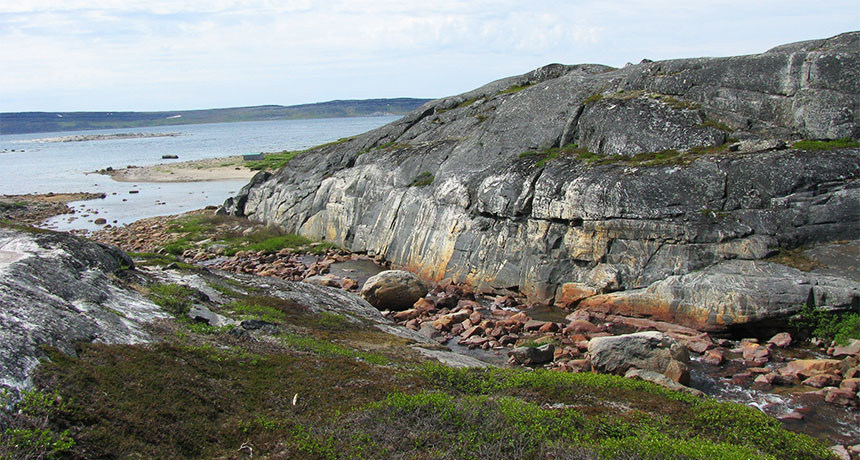
The new discovery fills in some of that history. In northeastern Canada, along the eastern shore of the Hudson Bay, O’Neil and geochemist Richard Carlson of the Carnegie Institution for Science in Washington, D.C., discovered 2.7-billion-year-old continental rocks that hinted at something much older. The rocks contain an unusually large abundance of an isotope of neodymium that formed only during the first few hundred million years of Earth’s history. To have so much of this neodymium, the rocks must have formed from material that was first created more than 4.2 billion years ago, the researchers calculate. That’s far older than the oldest rocks ever studied.
Based on the composition of the Canadian rocks, the researchers think that the precursor material was similar to the crust that underlies modern oceans. The finding affirms previous studies that suggested that the first continental crust arose from the partial melting of oceanic crust (SN Online: 9/20/16).
But unlike modern oceanic crust, which typically lingers for less than 200 million years before getting recycled into Earth’s interior by plate tectonics, the precursor crust survived for more than a billion years before being reworked into continental crust 2.7 billion years ago. Plate tectonics during the precursor crust’s life span must have therefore been nonexistent, sluggish or limited to certain regions, O’Neil concludes.
“If you ask five geologists the simple question of when did plate tectonics start, you’ll have answers from 4.3 billion years ago to 1 billion years ago,” he says. The new finding seems to rule out the idea that full-blown, global plate tectonics began early in Earth’s history.
The new work is exciting and sheds light on the processes that set the scene for Earth’s subsequent evolution and habitability, says geologist Tony Kemp of the University of Western Australia in Crawley. Other vestiges of early crust may lurk undiscovered elsewhere on Earth as well, he says. “It will be intriguing to see how this [research] unfolds with future studies of this type.”
The standard dinosaur family tree may soon be just a relic.
After examining more than 400 anatomical traits, scientists have proposed a radical reshuffling of the major dinosaur groups. The rewrite, reported in the March 23 Nature, upsets century-old ideas about dinosaur evolution. It lends support to the accepted idea that the earliest dinosaurs were smallish, two-legged creatures. But contrary to current thinking, the new tree suggests that these early dinosaurs had grasping hands and were omnivores, snapping up meat and plant matter alike. “This is a novel proposal and a really interesting hypothesis,” says Randall Irmis, a paleontologist at the Natural History Museum of Utah and the University of Utah in Salt Lake City. Irmis, who was not involved with the work, says it’s “a possibility” that the new family tree reflects actual dinosaur relationships. But, he says, “It goes against our ideas of the general relationships of dinosaurs. It’s certainly going to generate a lot of discussion.”
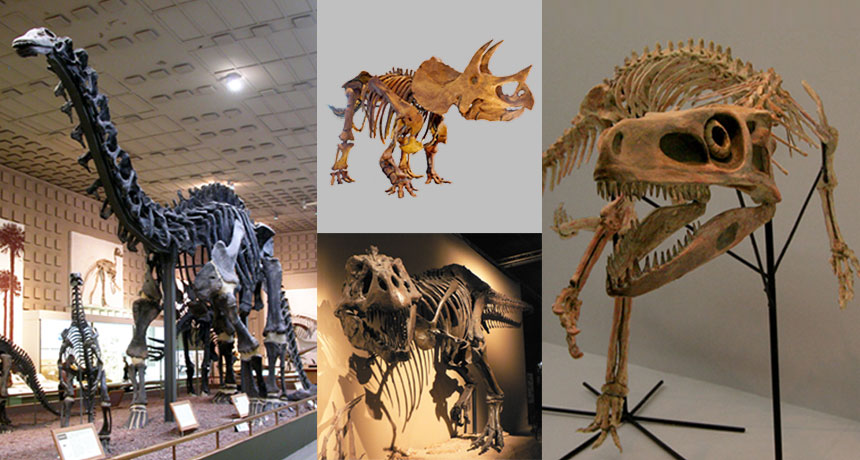
The accepted tree of dinosaur relationships has three dominant branches, each containing critters familiar even to the non–dinosaur obsessed. One branch leads to the “bird-hipped” ornithischians, which include the plant-eating duckbills, stegosaurs and Triceratops and its bony-frilled kin. Another branch contains the “reptile-hipped” saurischians, which are further divided into two groups: the plant-eating sauropods (typically four-legged, like Brontosaurus) and the meat-eating theropods (typically two-legged, like Tyrannosaurus rex and modern birds). This split between the bird-hipped and reptile-hipped dinos was first proposed in 1887 by British paleontologist Harry Seeley, who had noticed the two strikingly different kinds of pelvic anatomy. That hypothesis of dinosaur relationships was formalized and strengthened in the 1980s and has been accepted since then.
The new tree yields four groups atop two main branches. The bird-hipped ornithischians, which used to live on their own lone branch, now share a main branch with the reptile-hipped theropods like T. rex. This placement suggests these once-distant cousins are actually closely related. It also underscores existing questions about the bird-hipped dinos, an oddball group with murky origins; they appear late in the dinosaur fossil record and then are everywhere. Some scientists have suggested that they evolved from an existing group of dinosaurs, perhaps similarly herbivorous sauropods. But by placing the bird-hipped dinos next to the theropods, the tree hints that the late-to-the-party vegetarian weirdos could have evolved from their now close relatives, the meat-eating theropods.
Sauropods (like Brontosaurus) are no longer next to the theropods but now reside on a branch with the meat-eating herrerasaurids. Herrerasaurids are a confusing group of creatures that some scientists think belong near the other meat eaters, the theropods, while others say the herrerasaurids are not quite dinosaurs at all.
The new hypothesis of relationships came about when researchers led by Matthew Baron, a paleontologist at the University of Cambridge and Natural History Museum in London, decided to do a wholesale examination of dinosaur anatomy with fresh eyes. Using a mix of fossils, photographs and descriptions from the scientific literature, Baron and colleagues surveyed the anatomy of more than 70 different dinosaurs and non-dino close relatives, examining 457 anatomical features. The presence, absence and types of features, which include the shape of a hole on the snout, a cheekbone ridge and braincase anatomy, were fed into a computer program, generating a family tree that groups animals that share specialized features.
In this new interpretation of dinosaur anatomy and the resulting tree, many of the earliest dinosaurs have grasping hands and a mix of meat-eating and plant-eating teeth. If the earliest dinos were really omnivores, given the relationships in the new four-pronged tree, the evolution of specialized diets (vegetarians and meat eaters) each happened twice in the dinosaur lineage.
When the researchers saw the resulting tree, “We were very surprised — and cautious,” Baron says. “It’s a big change that flies in the face of 130 years of thinking.”
The arrangement of the new tree stuck even when the researchers fiddled around with their descriptions of various features, Baron says. The close relationship between the bird-hipped, plant-eating ornithischians and the reptile-hipped, meat-eating theropods, for example, isn’t based on one or two distinctive traits but on 21 small details.
“The lesson is that dinosaur groups aren’t characterized by radical new inventions,” says paleontologist Kevin Padian of the University of California, Berkeley. “The relationships are read in the minutiae, not big horns and frills.” That said, Padian, whose assessment of the research also appears in Nature, isn’t certain that the new tree reflects reality. Such trees are constructed based on how scientists interpret particular anatomical features, decisions that will surely be quibbled with. “The devil is in the details,” Padian says. “These guys have done their homework and now everyone’s going to have to roll up their sleeves and start checking their work.”
Where I grew up in Tennessee, a coal-fired power plant perches by the river, just down from the bridge that my wild brothers and their friends would jump off in the summer. Despite the proximity, I never thought too much about the power plant and the energy it was churning out.
But then I read an April 3 Nature Energy paper on coal-fired energy production that used my town — and others in the Tennessee Valley Authority area — as a natural experiment. The story the data tell is simultaneously fascinating and frustrating, and arrives at a politically prescient time. In recent weeks, the Trump administration has signaled a shift in energy policy back toward the fossil fuel.
The roots of this story were planted in the 1930s, when the TVA was created as a New Deal project to help haul America out of the Great Depression. The organization soon got into the power business, relying on a mix of energy sources: hydropower, coal and nuclear. After the 1979 accident at Three Mile Island — a nuclear power plant in Pennsylvania — stricter regulations driven by public fear prompted TVA to shut down its two nuclear reactors. Those temporary closures in 1985 left a gaping hole in the region’s energy production, a need immediately filled by coal.
Economist Edson Severnini realized that this dramatic shift from nuclear to coal offered a chance to study the effects of coal-fired power on health. He analyzed power production, particle pollution and medical records of babies born near coal plants. One in particular picked up the most slack: Paradise Fossil Plant in Paradise, Ky. (Incidentally, that town is the same coal-ravaged one John Prine sings about in arguably the best song ever written.) The plant’s power production increased by about 27 percent, replacing about a quarter of the missing nuclear energy.
Not surprisingly, air pollution near the Paradise plant rose, Severnini found. The levels of an air pollution indicator called total suspended particulate fell below the Environmental Protection Agency’s limit at the time (but wouldn’t have passed today’s tougher standards, Severnini says). Still, babies born near the plant in the 18 months after the nuclear shutdowns in 1985 were about 5 percent smaller than babies born in the 18 months before. No difference in birth weight showed up in babies born near other power plants that didn’t change their output (including my town’s). That 5 percent difference was “really, really surprising,” says Severnini, of Carnegie Mellon University in Pittsburgh. Studies have linked low birth weight to trouble later in life, including a lower IQ, lower earnings and health problems, particularly heart disease. UCLA environmental epidemiologist Beate Ritz puts that 5 percent drop in context. “These coal-fired power plants coming online can be compared with a pregnant woman smoking one pack of cigarettes a day,” she says. “That’s pretty bad.”
Ritz, who studies the hazards of air pollution in Los Angeles, points out that it’s not just the lowest birth weight babies affected. The whole curve of birth weights shifted, so that in all likelihood, most babies born there were impacted in some way. “There’s only a small percent in the upper end of the curve that is unaffected,” she says. “Everybody else has probably some kind of subtle effect that you can’t measure on their brain development, on their lung development, on their immune system.”
The study compares nuclear energy to coal. But the issue is far more complex than that, Severnini says. He hopes the example he found will serve as a reminder of how all energy decisions come with complex trade-offs. “Any energy production choice we make has costs and benefits, and we need to weigh them fully.”
The TVA case study fits with many other examples of how coal pollution can harm health, says Bernard Goldstein, a physician and environmental public health expert at University of Pittsburgh. “We should get rid of particulates, and coal contributes to that,” he says.
U.S. dependence on coal is ebbing, in part because natural gas is cheap right now. But coal isn’t dead yet. “My administration is putting an end to the war on coal,” President Donald Trump said March 28, before he signed an executive order that lifted the ban on coal leases on federal land. He also aims to lift other restrictions that affect the coal industry. It’s not yet clear how — or whether —those policies will be enacted, or whether they’ll be enough to revive the coal industry. (Tellingly, the Paradise plant plans to shut down two of its three coal-burning units as it shifts to natural gas.)
“If the president gets his way, this would slow [coal’s descent] down,” says Goldstein, who coauthored a March 23 New England Journal of Medicine opinion piece on why the Trump administration should pay attention to environmental science. Goldstein likens the situation to government efforts to discourage teenage smoking, a trend that’s also decreasing. Just because the numbers are already falling doesn’t mean we shouldn’t hasten that drop, he says.
And unlike exposure to other pollutants like cigarette smoke, air isn’t optional. “You don’t have a choice,” Ritz notes. We are all breathing the air that’s around us, whether we are in Paradise or not.