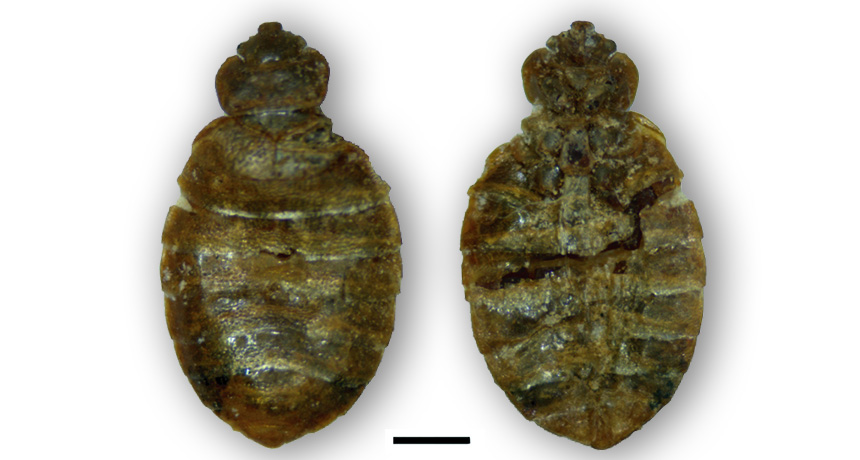
The oldest known specimens of bedbug relatives have been unearthed in an Oregon cave system where ancient humans once lived. The partial fossils from three different species in the bedbug family date back 5,000 to 11,000 years, predating a previous find from 3,500 years ago, researchers report April 4 in the Journal of Medical Entomology.
“The bedbugs that we know in modern times originated as bat parasites, and it’s believed that they became human parasites when humans lived in caves with bats,” says study coauthor Martin Adams of Paleoinsect Research in Portland, Ore. When humans moved elsewhere, bedbugs came along for the ride.
These three species (Cimix antennatus, Cimex latipennis and Cimex pilosellus) probably coexisted with humans in Oregon’s Paisley Five Mile Point Caves, and probably snacked on people at least occasionally, Adams says. Even though all three species are still around today, they still feast mostly on bats.
Archaeologists think that ancient humans lived in the Paisley Caves only seasonally, which could explain why these particular species of bedbugs didn’t switch to a human-centric diet.
The solar system doesn’t have a long, twisted tail after all.
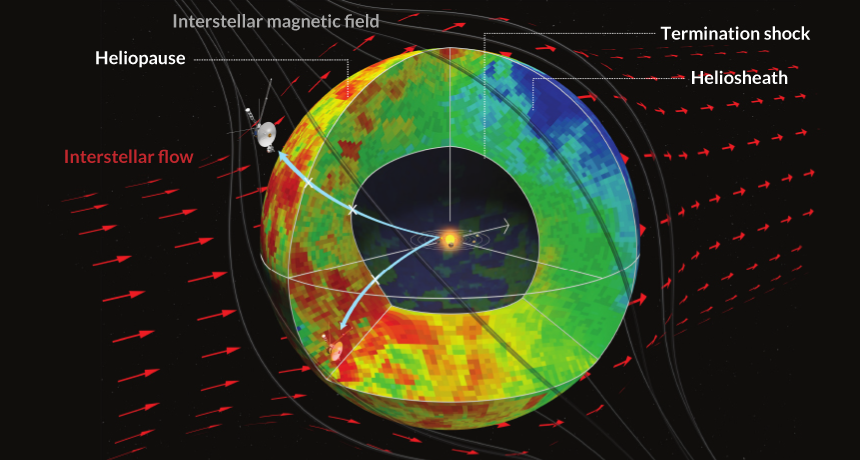
Data from the Cassini and Voyager spacecraft show that the bubble of particles surrounding the solar system is spherical, not comet-shaped. Observing a spherical bubble runs counter to 55 years of speculation on the shape of this solar system feature, says Tom Krimigis of the Johns Hopkins Applied Physics Laboratory in Laurel, Md. He and colleagues report the result online April 24 in Nature Astronomy. “You can’t really argue with the new result,” says Merav Opher of Boston University, who was not involved in the study. “The data so loudly say that there is no tail.”
The bubble, called the heliosphere, is inflated by particles streaming from the sun and envelops all of the material in the solar system. Its shape is important because it provides clues about how the solar system interacts with interstellar space.
In the 1960s, researchers proposed that the heliosphere was either shaped like a comet or was spherical. Magnetic fields surrounding the sun and the planets look sort of like comets, with long tails extending behind them. So, scientists speculated that the heliosphere would have a tail, too. In 2013, data from the Interstellar Boundary Explorer, or IBEX, spacecraft found signs that the tail assumption was right. The probe counted the number of fast-moving atoms that are thought to be kicked inward from the edge of the solar system when they collide with charged particles from the sun. Detecting those atoms offers clues to the shape of the heliosphere, and the images suggested that solar system had a long, twisted tail that looked like a four-leaf clover (SN: 8/24/13, p. 9).
But it wasn’t clear from the data exactly how far away from the spacecraft the atoms were and therefore how far the heliosphere’s tail extended, Krimigis says. By combining more than a decade’s worth of data from the Voyager and Cassini probes, he and colleagues sought a clearer picture. The team specifically tracked how the abundance of the speedy atoms changed in different parts of the heliosphere as the intensity of charged particles streaming from the sun, the solar wind, waxed and waned.
At the front of the heliosphere, where the Voyager probes sit, when the intensity of the solar wind decreased, so did the abundance of speedy atoms. When it increased, the number went up, in lockstep. Looking at speedy atoms at the back of the heliosphere, the team saw the same changes. If there were a long tail, Krimigis says, the changes in the number of atoms wouldn’t be the same in both directions. Because the atoms would have farther to travel in a tail, it would take longer for their abundance to build up there again.
While the observational evidence now favors a spherical shape for the heliosphere, recent simulations suggest something more exotic. The bubble might actually be shaped like a croissant, Opher says. The simulations, which incorporate data from Voyager 1, show that the interaction of the magnetic fields from the sun and interstellar space squish the solar wind into two jets — what might be observed as two short tails. These jets haven’t been detected yet. But if they are, she says, they could give clues to other sets of jets seen in the universe such as those shooting from young stars or possibly even black holes.
Most people who eat octopus prefer it immobile, cut into pieces and nicely grilled or otherwise cooked. For some, though, the wiggly, sucker-covered arms of a live octopus are a treat — even though those arms can stick to the throat and suffocate the diner if they haven’t been chopped into small enough pieces.
Dolphins risk the same fate when eating octopus — and they can’t cook it or cut it up with a chef’s knife. “Octopus is a dangerous meal,” notes Kate Sprogis of Murdoch University in Australia. Even if a dolphin manages to remove an octopus’ head, it still has to deal with those sucker-covered tentacles. “The suckered arms would be difficult to handle considering dolphins don’t have hands to assist them,” Sprogis says.
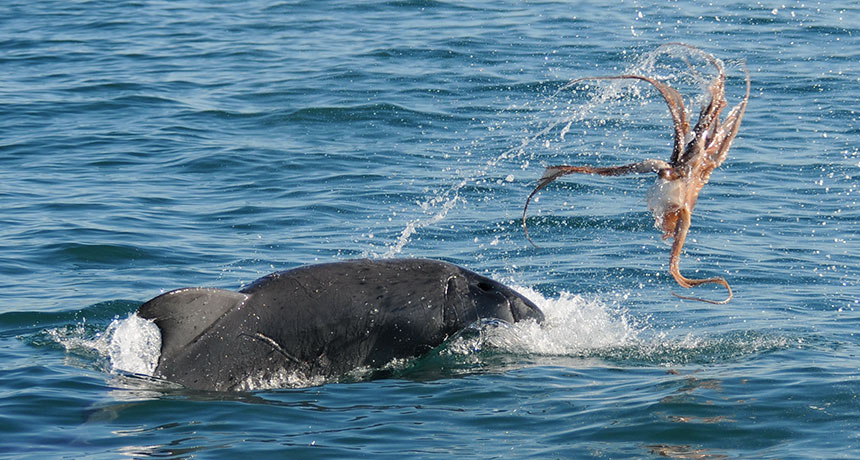
A group of hungry dolphins off the coast of Western Australia have figured out a solution. They shake and toss their prey until the head falls off, the animal is in pieces and its arms are tender and not wiggling anymore, Sprogis and her colleagues report April 2 in Marine Mammal Science.
The behavior, never before reported, was discovered during observations between March 2007 and August 2013 of bottlenose dolphins living in the waters off Bunbury, Western Australia. During that time, researchers witnessed 33 events in which dolphins handled an octopus with two different methods.
In one technique, a dolphin held an octopus in its mouth and shook it, slamming its prey into the water’s surface until the meal was in pieces. Each dolphin would repeat its preferred motion, or combine the two, usually around a dozen times, over several minutes until the octopus was safe to eat. (See video below.)
“If the dolphins haven’t prepared their meal enough, then this can cause problems,” Sprogis notes. There have been two dead dolphins found in this area with whole octopuses lodged in their throats. The researchers assume that the dolphins suffocated.
Dolphins have garnered a reputation for tackling difficult-to-eat foods in creative ways. Some have been spotted using cone-shaped sponges to flush out little fish from the sandy ocean floor. Others use a six-step process to prepare a cuttlefish meal. The Bunbury dolphins eat both octopus and cuttlefish, and those meals appear to be more common in the winter and spring, when waters are cooler, Sprogis notes. That may be when the octopus and cuttlefish breed and lose some of their camouflage abilities — making them easy prey for dolphins brave or knowledgeable enough to take advantage of the potential meal.
A stone tool found in Syria more than 80 years ago has sharpened scientists’ understanding of Stone Age networking.
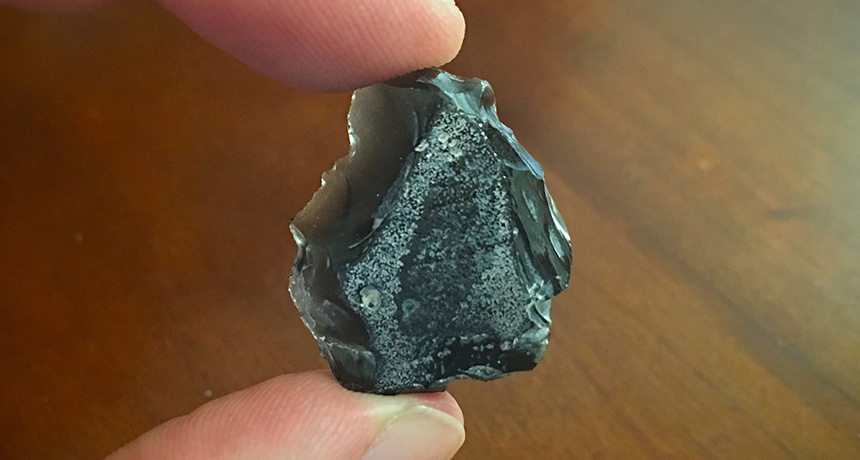
Small enough to fit in the palm of an adult’s hand, this chipped piece of obsidian dates to between 41,000 and 32,000 years ago, say archaeologists Ellery Frahm and Thomas Hauck. It was fashioned out of volcanic rock from outcrops in central Turkey, a minimum of 700 kilometers from where the artifact was found, the researchers report in the June Journal of Archaeological Science: Reports. Until now, the earliest transport of obsidian into the Middle East was thought to have occurred between 14,500 and 11,500 years ago, when Natufian foragers began to live in year-round settlements (SN: 9/25/10, p. 14). Someone probably shaped the obsidian chunk into a usable tool near its Turkish source, say Frahm, of Yale University, and Hauck, of the University of Cologne in Germany. The tool, which could have been used for various cutting and scraping tasks, was then passed from one mobile group to another, perhaps several times, before reaching Syria’s Yabroud II rock-shelter. Along the way, the implement underwent reshaping and resharpening.
The most direct path between the Turkish and Syrian sites stretches about 700 kilometers. But hunter-gatherers meander, following prey animals and searching for other food. So, Stone Age bearers of the obsidian tool probably traveled considerably farther to reach one of several rock-shelters clustered near what’s now the Syrian town of Yabroud, the investigators say. “They didn’t type ‘Yabroud’ into a GPS unit and make their way to the rock-shelter as fast as possible,” Frahm says. Excavations at the Yabroud sites between 1930 and 1933 yielded the obsidian tool and hundreds of artifacts made from a type of rock called chert found a mere five to 10 kilometers away. Some researchers suspect the obsidian tool was mistakenly included among much older finds shortly after being excavated. But a copy of the lead excavator’s book describing his fieldwork, housed at Yale, confirms that the implement was found in sediment dating to around the time ancient humans and Neandertals inhabited the Middle East, Frahm says. Since excavators did not collect material for radiocarbon dating, Frahm and Hauck estimated the Syrian rock-shelter’s age by comparing its sediment layers and artifacts with those at several nearby, better-dated sites. Neandertals survived in the Middle East and elsewhere until at least 40,000 years ago (SN: 9/20/14, p. 11), so they might have been the final recipients of the obsidian tool. But Frahm considers Homo sapiens a better candidate. Humans occupied the Middle East and nearby regions throughout the period when the tool may have been used. No hominid fossils have been recovered at the Syrian site.
Using a portable X-ray device, Frahm and Hauck determined the chemical composition of the obsidian tool and 230 obsidian samples from known sites throughout southwestern Asia. That let the researchers match the Syrian find to its Turkish source.
Outside the Middle East, previous evidence suggested that long-distance obsidian transport occurred in Stone Age Eurasia. Researchers reported in 1966 that two obsidian pieces with sharpened edges found at northern Iraq’s Shanidar Cave originated roughly 450 kilometers to the north. That analysis used an earlier technique for measuring a stone’s chemical composition. Shanidar’s obsidian finds date to about the same time as that of the Yabroud II obsidian tool, perhaps to as early as 48,000 years ago, Frahm says.
Recent investigations of obsidian artifacts at late Stone Age sites in Eurasia not far from Shanidar Cave, in what’s now Armenia and Georgia, indicate that hunter-gatherers there also exploited vast territories, says archaeologist Daniel Adler of the University of Connecticut in Storrs. Frahm has contributed to some of that research. As for the Yabroud II obsidian tool, “a 700-kilometer transport distance is fully within the realm of possibility for a single person over an extended period of time,” Adler says.
Eurasia may have a far older tradition of extensive hunter-gatherer networking than the Middle East does. Evidence of long-distance obsidian transport in Armenia dates to as early as around 500,000 years ago, notes archaeologist Andrew Kandel of the University of Tübingen in Germany. That means Neandertals or other now-extinct hominid species first transported obsidian across hundreds of kilometers, he says.
People may think they act independently. But we catch social behaviors faster than colds. Whether or not we vote, try a new food or wear clear plastic pants will have something to do with whether other people are doing it. Unfortunately, it’s often hard to prove exactly how contagious a particular behavior is, or which behaviors will actually spread.
A new study shows that among runners using a fitness social network, logging miles is infectious — if the runner you’re comparing yourself to is slightly worse than you. The work shows a clever new way to determine if a behavior is socially contagious. But the results also confirm something about runners: We might be a little too competitive.
Glance at any group of kids with fidget spinners or teens wearing the same brand of shoes, and it’s easy to buy into the idea of social contagions. But it’s actually not so simple to distinguish between that kind of peer influence and other outside factors. says Johan Ugander, an applied mathematician at Stanford University. It’s easy for marketers to say they want something to go viral. But it’s a lot harder to be confident that the thing that’s spreading is really a social contagion and not a common factor like location or a group of people with common interests.
For one thing, birds of a feather really do flock together. People become friends because they have things in common. You might share an important article to Facebook, and find a friend has shared the same article 20 minutes later. But is that because you influenced your friend? Or because you have the same interests and read the same kind of articles, and you just happened to see it 20 minutes before they did?
Similarly, people tend to have friends who are near them geographically. So if two neighbors gain weight, Ugander notes, it could be “because the McDonald’s opened down the street, not because I gained weight then you gained weight.”
To get around this problem of homophily, Sinan Aral, a computational social scientist at MIT, decided to look at a single behavior — running. “Running is one of the most pervasive forms of this type of exercise,” he says. “I thought it would be most generalizable.”
Runners also like to log their miles and share them with their peers. Aral was able to get data from one of several social media platforms designed for jogging buffs. Aral can’t disclose the exact app or program he used in the study (and received some funding from), but there are a few social apps out there that fit the bill, including MapMyRun, RunKeeper and Strava. Aral ended up with a vast, anonymized dataset of more than 1.1 million runners who logged more than 359 million kilometers (223 million miles) over five years. To figure out if running is contagious, there would have to be a way to make some people run and other people stay home. “The ideal study to show [a causal effect] would be to go around with a cattle prod, prodding some people to exercise more,” but leaving others alone, Aral says. “But that’s not an experiment you can run.” (Obviously.)
So Aral and colleagues used the weather as their cattle prod. Good weather beckons a runner outdoors. Rain, snow, sleet or hail will keep a runner off the street. The researchers combed through data, noting what the weather was like on a given day and how far a runner went. They then compared that runner’s logs to their friends in other cities — places far enough away that the weather would be different. With the weather serving as the prod for some to put on their running shoes or keep others at home, the scientists got a good idea of who socially infected who with the running bug.
They found that for every additional kilometer run by someone’s distant friends, the runner would add another 0.3 km (0.18 mi). Timewise, a friend spending an additional 10 minutes running will inspire an extra three minutes in someone else, Aral and his group reported April 18 in Nature Communications.
But social contagion didn’t affect everyone the same way. The runners most influenced were those who compared themselves to runners slightly worse than they were. “In the loose analogy of a race, I’m more motivated by the guy behind me than I am motivated by the person ahead of me,” Aral says.
The study also showed some gender effects. Men were most influenced by other men, but were also ready to outrace the women. In contrast, women did not tend to be influenced by men. “There have been experimental studies showing men are more competitive with one another, while women are more self-directed and motivated by internal factors,” Aral says. But that doesn’t mean that women aren’t competitive. Women were just influenced by other women.
“It’s usually very difficult to identify causal effects from correlational data, in the absence of a randomized controlled trial,” says Edoardo Airoldi, a statistician at Harvard University. The data in this study may not translate to other behaviors — even to other forms of exercise. But that isn’t the point. The beauty, Airoldi says, is in the methods. “People should know you can use the weather as an instrument to uncover patterns of human behavior that are otherwise hard to elicit,” he says.
Ugander is also a fan of the new study, but he notes that this doesn’t mean all social behaviors, or even all sports, will prove similarly contagious, especially with regard to the gender differences. “It’s not clear that that will generalize to yoga or some other sport with other gender norms,” he says.
We don’t really know what exactly drives social contagion. One theory — the complex contagion theory — posits that costly behaviors (like going for an exhausting run) require a lot of signals from a lot of people. In other words, the more people in your network are running, the more likely you are to run.
Another theory developed by Ugander’s group posits that it’s not quantity that matters, but variety, a theory called structural diversity. Your family all going running is one thing. A family member, a friend and coworker is another. “If you’re getting it from two people from different parts of your life, say sibling and coworkers, it carries more weight,” Ugander says. “But two coworkers probably got it from each other.”
A third theory suggests that embeddedness — the number of mutual connections — matters most. After all, seeing all your friends virtuously running and knowing that they are also seeing each other live the wholesome life is a lot of peer pressure.
The data from Aral’s group suggests that for running, embeddedness and structural diversity may prove the most catching. “This doesn’t mean the complex theory is wrong,” Aral notes. “We just didn’t see it for running.”
Aral himself is a runner, and admits he’s not immune to the social contagion he found. “When I have friends who are close to me in fitness in terms of their level of activity, I may be influenced,” he says. “I also feel like I’d be more influenced by someone who was slightly less of a runner than I am. If they were running more, I would think, ‘Wow, even so-and-so is out there, I need to get out there.’” This social behavior might be catching, but the vulnerable population already has a raging competition infection.
A weird new particle imitator flouts the established rules of particle physics. The discovery could help scientists simulate how particles behaved just after the Big Bang or lead to the development of new devices with unusual electromagnetic properties.
The curious new phenomenon involves a particle-like entity called a quasiparticle, formed from a jostling mosh pit of electrons that collectively act like a single particle in a solid. Found in a compound of lanthanum, aluminum and germanium, the new quasiparticle is a bit of a renegade, physicist M. Zahid Hasan of Princeton University and colleagues report June 2 in Science Advances. Known as a type-II Weyl fermion, the quasiparticle breaks a rule called Lorentz symmetry, which states that the laws of physics are the same no matter the observer’s perspective, whether moving or stationary. Lorentz symmetry is the foundation of Einstein’s special theory of relativity, which details the physics of observers zipping along near the speed of light. For a real particle, violating Lorentz symmetry would be an unallowable faux pas, but for quasiparticles, the rules are looser, so type-II Weyl fermions can behave in a way a normal particle wouldn’t.
Fermions are a class of elementary particle that includes quarks, which make up protons and neutrons, and electrons. There are three different types of fermions: Dirac, Majorana and Weyl. Dirac fermions are the garden-variety type and include electrons and quarks. Majorana fermions are their own antiparticles. Neutrinos, notoriously lightweight and elusive particles, could be either Majorana or Dirac fermions; scientists aren’t yet sure which.
Weyl fermions are a massless variety of fermion. No examples have been found in particle physics. But the quasiparticle version of Weyl fermions burst onto the scene in 2015, when scientists first discovered them in a compound made of tantalum and arsenic (SN: 8/22/15, p. 11). Soon, scientists realized that their Lorentz-violating relatives, type-II Weyl fermions, might likewise pop up in solids.
In the new study, Hasan and colleagues measured the relationship between the energy and momentum of the quasiparticles, showing that they were consistent with type-II Weyl fermions. Although previous experiments have shown hints of the unusual quasiparticles, those measurements were skin-deep, assessing particles only on the surface of the material, Hasan says. With surface measurements alone, it’s hard to confirm the type-II Weyl fermions are there, says physicist Alexey Soluyanov of ETH Zurich. But Hasan and colleagues peered inside the material. “Experimentally, this work really is a nice example,” Soluyanov says.
In solids, Weyl fermions lead to unusual behavior. Put a normal material in a magnetic field, and resistance to the flow of electricity grows, but in a solid with Weyl fermions, a magnetic field makes current flow more easily. Type-II Weyl fermions are even stranger, due to their Lorentz-violating properties. In a material with these quasiparticles, a magnetic field in one direction can increase conductivity, while in another direction it can decrease conductivity. “This type of thing can have interesting applications,” says Hasan. “In a single material, just by changing the direction of the field, now we can get different behaviors,” flipping between insulating and conducting, for example. The new material could also provide insight for particle physicists. “Of course, people have wondered what happens when you break Lorentz invariance,” says physicist Adolfo Grushin of Institut Néel in Grenoble, France. Type-II Weyl fermions could help scientists better understand theories that violate the rule. “It’s a good test-bed,” says Grushin.
For example, Hasan says, “we can test theoretical ideas in the early universe,” simulating how particles may have behaved just after the Big Bang, when Lorentz symmetry may not have been obeyed.
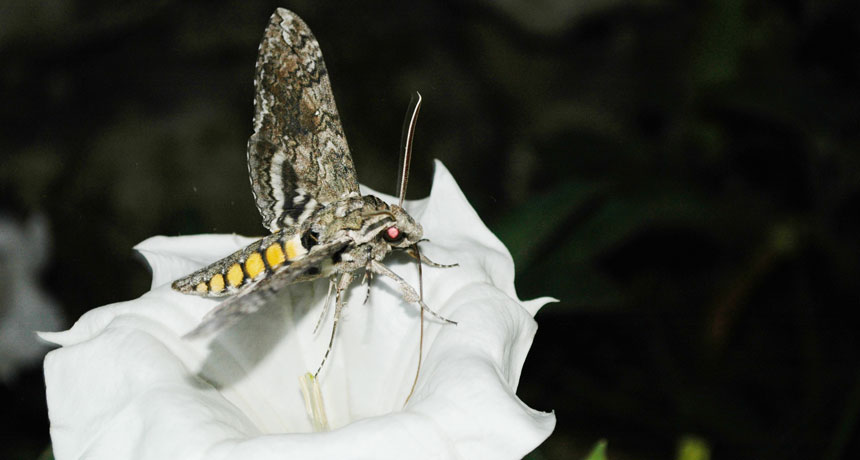
PORTLAND, ORE. — A great flower shape for a moth trying to get a drink in the dark turns out to be awful from the plant’s point of view.
Offering hawk moths (Manduca sexta) a range of 3-D printed flowers with different curvatures shows that a moderately curved trumpet shape lets moths sip most efficiently, Foen Peng reported June 24 at the Evolution 2017 meeting. That’s a win for a nocturnal flying insect searching for nectar. Yet drinking ease wasn’t best for the plant. During swift sips, the moths did less inadvertent bumping against the artificial flowers’ simulated sex organs than moths struggling to sip from an inconvenient shape. Less contact with real flower parts would mean less delivery and pickup of pollen.
Peng, of the University of Washington in Seattle, offered the moths three other shapes besides the gently curved trumpet. The best for the plant was a flat-topped “flower” with a right angle drop to a nectar well in the center. Previous work suggested that lack of curves made it very difficult for hawk moths hovering above a flower and extending their tonguelike proboscises to tap and probe the way to nectar in dim light.
Pollination at first glance may look like an easy mutualism evolving with the best interests of both plant and pollinator. But these experiments reveal a hidden, underlying conflict, Peng said.
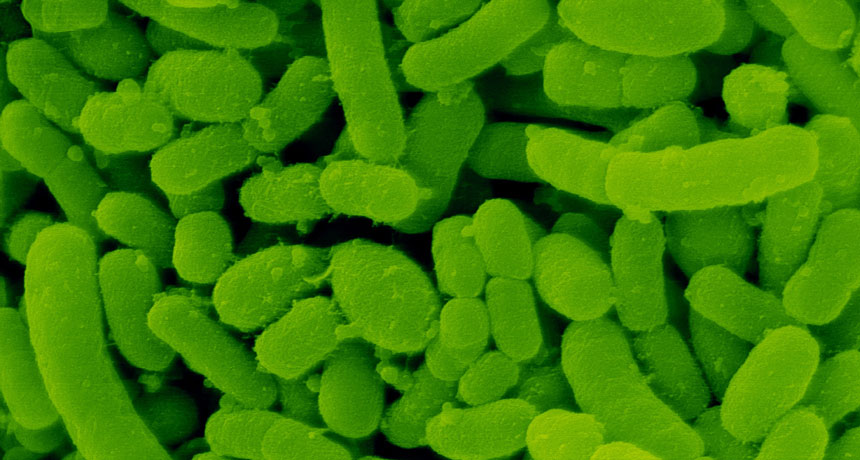
Out-of-whack microbes in the vagina can raise HIV risk — and now there’s evidence that the makeup of the penis microbiome matters, too. The greater the number of anaerobic bacteria tucked under the foreskin, the more likely an uncircumcised man is to become infected with the virus, researchers report July 25 in mBio.
“This mirrors what’s been seen in women, but it’s the first study of its kind in men,” says Deborah Anderson, a microbiologist and gynecologist at Boston University School of Medicine. The data come from heterosexual Ugandan men followed for two years as part of a larger study on circumcision. Researchers swabbed the men’s penises to collect bacteria samples at the beginning of the two-year study. Then they compared the penile bacterial composition of the 46 uncircumcised men who became infected with HIV over the course of the study with that of 136 uncircumcised men who didn’t.
The total amount of penile bacteria didn’t differ, but men with higher levels of anaerobic bacteria were more likely to have contracted HIV, researchers found. Having 10 times more Prevotella, Dialister, Finegoldia and Peptoniphilus bacteria raised the risk of contracting HIV by 54 to 63 percent after controlling for other factors that might affect risk, such as condom use habits and number of sexual partners.
The results might help explain why circumcision cuts the risk of HIV, says Thomas Hope, a cell biologist at Northwestern University Feinberg School of Medicine in Chicago: Removing the flap of foreskin takes away a moist hideout for bacteria that thrive in oxygen-starved environments. But, Hope cautions, the study only draws an association between the microbiome and HIV — not necessarily a cause and effect.
It’s not clear how certain bacteria might raise HIV risk, but the new study revealed one possible clue: Men with more anaerobic penis bacteria also had higher levels of inflammatory cytokine proteins, which call immune cells to the scene.
“Specific bacteria might cause inflammatory response that would cause the immune cells to congregate in the penis, where they’re more likely to be exposed to the virus,” says study coauthor Cindy Liu, a pathologist at George Washington University in Washington, D.C. HIV targets particular immune cells, so recruiting an immune response to the penis might have an unintended consequence — a free ferry ride for the virus into the bloodstream. Liu and colleagues hope to test that explanation more thoroughly by looking at tissue samples from circumcised foreskins, and seeing whether there’s a relationship between the penis microbiome and the kinds of immune cells found in the foreskin.
Some of these same bacteria are also linked to increased HIV risk in women, and the microbes can be swapped between partners during sex. While practicing safe sex is still the best HIV-prevention strategy, topical creams that adjust the bacterial balance on the penis might someday help lower the risk of infection, Liu says.
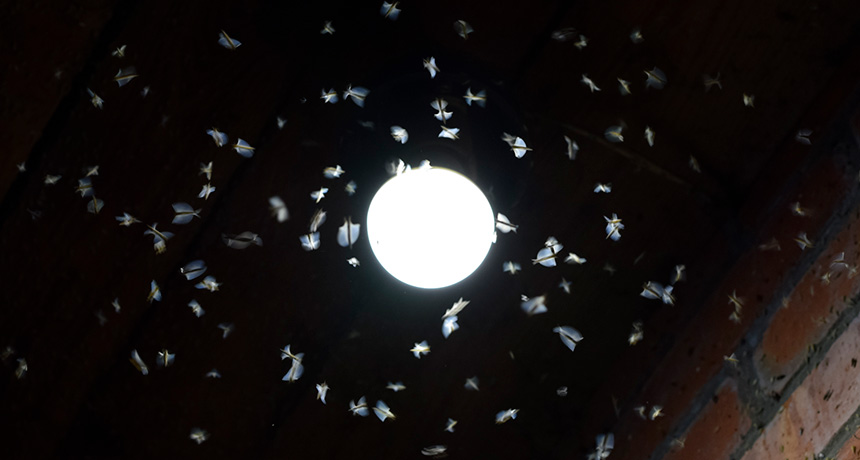
For flowers, too much light at night could lead to a pollination hangover by day.
Far from any urban street, researchers erected street lights in remote Swiss meadows to mimic the effects of artificial light pollution. In fields lit during the night, flowers had 62 percent fewer nocturnal visitors than flowers in dark meadows, researchers report August 2 in Nature.
For one of the most common flowers, daytime pollination didn’t make up for nightly losses, says ecologist Eva Knop of the University of Bern in Switzerland. In a detailed accounting of the pollination life of cabbage thistles (Cirsium oleraceum), Knop and colleagues found that night-lit plants produced 13 percent fewer seeds overall than counterparts in naturally dark places. Night lights could affect the entire network of plants and pollinators, the team suggests. In the test fields, nighttime pollination wasn’t just the business of a few kinds of specialized moth-loving plants. Flowers that fed a wide range of nighttime visitors also attracted a broad buzzing circus of different kinds of daytime pollinators. If the daytime insects don’t make up for nocturnal losses, a flower’s population might dwindle. And a lot of insects, both day and night, might then feel the loss of nectar and foliage, Knop says.
More than 80 percent of flower species get some help from animals in making seeds, and none evolved with light after sundown. “I hope people start to realize that it’s really something that changes the whole ecosystem,” Knop says. The new study is the first to show how artificial light affects plants’ ability to make seeds, she says. The test is also unusual because it considers all kinds of insect pollinators instead of focusing on, say, only night-flying moths. This big-picture view was so not easy to achieve. Finding possible dead-dark sites in highly developed Europe to set up LED lamps was impossible, so researchers worked in 14 dark-as-possible, remote meadows in land rising toward the Alps. But that created a problem. “If you don’t have light, you don’t have power,” Knop points out. To avoid generator growls and smells confounding their results, researchers painstakingly scouted sites where possible near water-powered energy sources and overall used “really long cables.” For the sites with natural night, researchers measured pollination by patrolling set paths and catching any insect wriggling on a flower — in complete darkness, of course. The team used night-vision goggles but still didn’t have a perfect view, she says. It’s “not that easy to catch insects without three-dimensional vision.”
Besides paying special attention to the commonly visited cabbage thistle, researchers pieced together the whole network of which pollinator species visited which plant species day or night. Analysis of this Matterhorn of data suggested that changes in the night crew could affect daytime meadows.
The idea that night light could have broad knock-on effects on daytime pollinators is still speculation at this point, says ecologist Darren Evans of Newcastle University in England, who also studies light pollution and pollination. But the risk of such spillover warrants more attention.
A boy who lived in what’s now South Africa nearly 2,000 years ago has lent a helping genome to science. Using the long-gone youngster’s genetic instruction book, scientists have estimated that humans emerged as a distinct population earlier than typically thought, between 350,000 and 260,000 years ago.
The trick was retrieving a complete version of the ancient boy’s DNA from his skeleton to compare with DNA from people today and from Stone Age Neandertals and Denisovans. Previously documented migrations of West African farmers to East Africa around 2,000 years ago, and then to southern Africa around 1,500 years ago, reshaped Africans’ genetics — and obscured ancient ancestry patterns — more than has been known, the researchers report online September 28 in Science. The ancient boy’s DNA was not affected by those migrations. As a result, it provides the best benchmark so far for gauging when Homo sapiens originated in Africa, evolutionary geneticist Carina Schlebusch of Uppsala University in Sweden and her colleagues conclude.
In line with the new genetically derived age estimate for human origins, another team has proposed that approximately 300,000-year-old fossils found in northwestern Africa belonged to H. sapiens (SN: 7/8/17, p. 6). Some researchers suspect a skull from South Africa’s Florisbad site, dated to around 260,000 years ago, qualifies as H. sapiens. But investigators often place our species’ origins close to 200,000 years ago (SN: 2/26/05, p. 141). There is broad consensus that several fossils from that time represent H. sapiens.
Debate over the timing of human origins will continue despite the new evidence from the child, whose remains came from previous shoreline excavations near the town of Ballito Bay, says Uppsala University evolutionary geneticist and study coauthor Mattias Jakobsson. “We don’t know if early Homo sapiens fossils or the Florisbad individual were genetically related to the Ballito Bay boy,” he says.
Thus, the precise timing of humankind’s emergence, and exact patterns of divergence among later human populations, remain unclear. Researchers have yet to retrieve DNA from fossils dating between 200,000 and 300,000 years old that either securely or possibly belong to H. sapiens. However early human evolution played out, later mixing and mingling of populations had a big genetic impact. DNA evidence from more recent fossils, including those studied by Schlebusch’s group, increasingly suggests that Stone Age human groups migrated from one part of Africa to another and mated with each other along the way (SN: 10/20/12, p. 9), says Harvard Medical School evolutionary geneticist Pontus Skoglund. In the Sept. 21 Cell, he and his colleagues report that DNA from 16 Africans, whose remains date to between 8,100 and 400 years ago, reveals a shared ancestry among hunter-gatherers from East Africa to South Africa that existed before West African farmers first arrived 2,000 years ago.
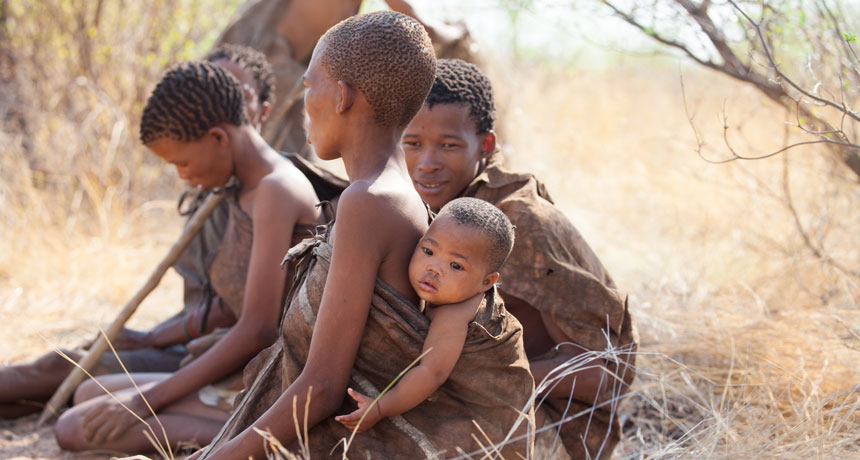
That ancient set of common genes still comprises a big, varying chunk of the DNA of present-day Khoisan people in southern Africa, Skoglund’s group found. Earlier studies found that the Khoisan — consisting of related San hunter-gatherer and Khoikhoi herding groups — display more genetic diversity than any other human population.
Schlebusch’s team estimates that a genetic split between the Khoisan and other Africans occurred roughly 260,000 years ago, shortly after humankind’s origins and around the time of the Florisbad individual. Khoisan people then diverged into two genetically distinct populations around 200,000 years ago, the researchers calculate.
Ancient DNA in Schlebusch’s study came from seven individuals unearthed at six South African sites. Three hunter-gatherers, including the Ballito Bay boy, lived about 2,000 years ago. Four farmers lived between 500 and 300 years ago.
Comparisons to DNA from modern populations in Africa and elsewhere indicated that between 9 percent and 30 percent of Khoisan DNA today comes from an East African population that had already interbred with Eurasian people. Those East Africans were likely the much-traveled farmers who started out in West Africa and reached southern Africa around 1,500 years ago, the researchers propose.